The AI Chip Wars: How Cerebras, NVIDIA, AMD, and Google TPU Stack Up in 2026
 Lorenzo Vallone
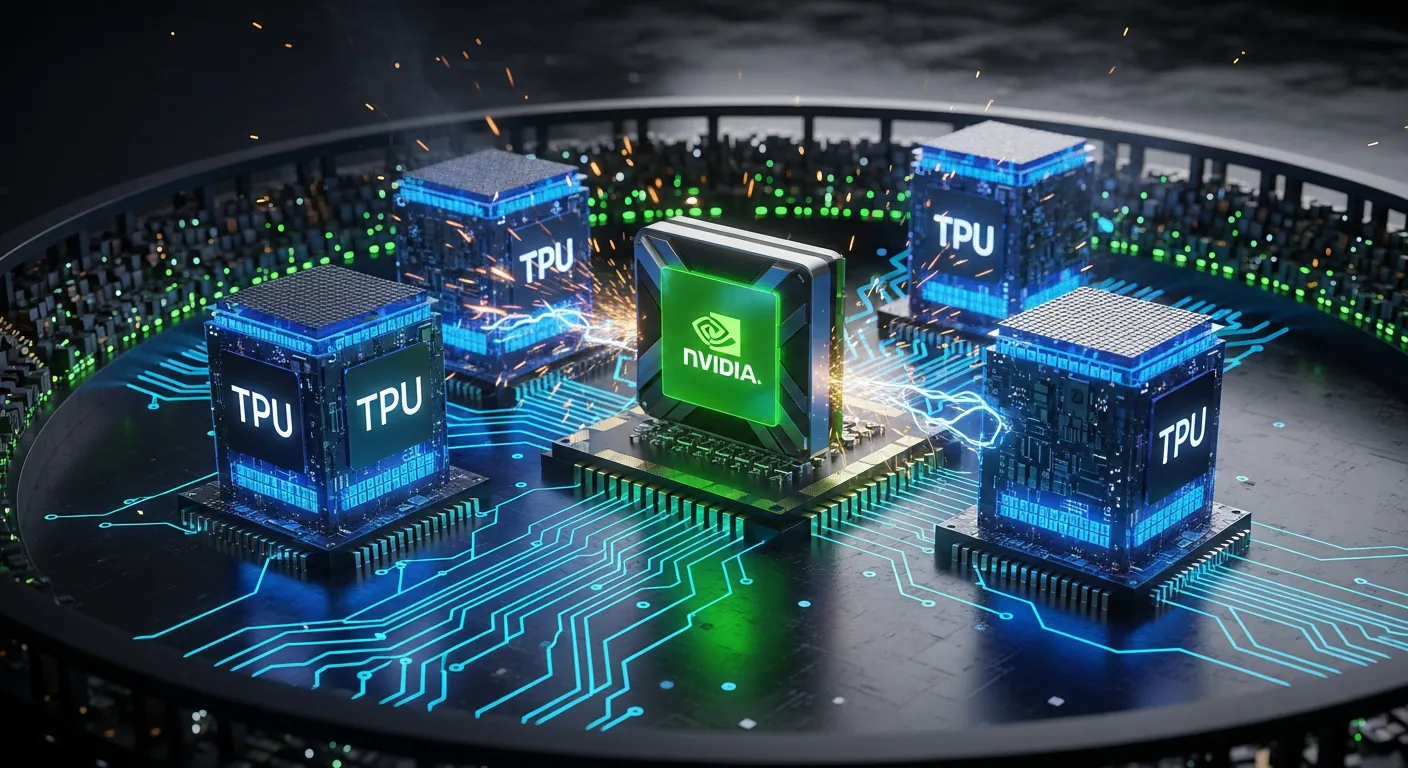
The Hardware Arms Race Powering AI
Behind every large language model, every AI-generated image, and every autonomous agent is a piece of specialized hardware doing trillions of calculations per second. For years, NVIDIA's GPUs have been the undisputed engine of the AI revolution. But as models grow larger and demand pushes the limits of physics, a new generation of challengers is emerging — each taking a fundamentally different approach to the same problem.
Understanding these architectures is no longer just for hardware engineers. If you are building with AI, investing in AI, or simply trying to understand where the industry is headed, the hardware layer is where the most consequential decisions are being made.
NVIDIA: The Incumbent Giant
NVIDIA's dominance in AI hardware is difficult to overstate. The company controls roughly 80% of the AI training market, and its CUDA software ecosystem — built over two decades with more than 4 million developers — has created what many consider the deepest competitive moat in all of technology.
The company's current flagship, the Blackwell B200, delivers approximately 9 petaflops of performance with 192 GB of HBM3e memory. The rack-scale GB200 NVL72 system connects 72 GPUs via NVLink, creating a liquid-cooled supercomputer in a single enclosure. For the majority of organizations training large models, NVIDIA remains the default choice — not because alternatives don't exist, but because the surrounding software ecosystem makes everything else feel like swimming upstream.
The tradeoff? Cost and power consumption. A single B200 chip draws over 1,000 watts, and the NVL72 rack consumes 132 kilowatts. At $30,000-$40,000 per chip, building a training cluster is a multi-million dollar investment before you write a single line of code.
Cerebras: The Wafer-Scale Disruptor
If NVIDIA's approach is to connect thousands of small chips together, Cerebras took the opposite path: build one enormous chip. The Cerebras WSE-3 (Wafer-Scale Engine) is, quite literally, an entire silicon wafer turned into a single processor. At 46,225 square millimeters, it is 57 times larger than NVIDIA's largest GPU.
The numbers are staggering. The WSE-3 contains 4 trillion transistors, 900,000 AI-optimized cores, and 44 GB of on-chip SRAM with 21 petabytes per second of memory bandwidth — roughly 7,000 times more bandwidth than an H100. By keeping everything on a single wafer, Cerebras eliminates the most persistent bottleneck in large-scale AI: the communication overhead between chips.
Where this matters most is inference speed. On Llama 3.1 70B, the WSE-3 delivers 2,100 tokens per second per user — 8 times faster than an H100 and twice as fast as Blackwell for single-user latency. For applications where response time is everything — real-time trading, conversational AI, medical diagnosis — that difference is transformative.
Cerebras has also made a compelling argument on simplicity. Training GPT-3 175B on their system requires approximately 565 lines of code. The equivalent NVIDIA setup, with its distributed training across thousands of GPUs, NVLink configuration, model parallelism, and gradient accumulation, typically requires over 20,000 lines.
The limitations are real, though. The 44 GB of on-chip memory means models must use weight streaming for anything that doesn't fit. The software ecosystem is young compared to CUDA. And each CS-3 system costs millions, putting it out of reach for most organizations. Cerebras is targeting an IPO in Q2 2026 at a reported $15 billion valuation, with a $10 billion OpenAI contract signed in early 2026 signaling serious enterprise traction.
AMD: The Memory Advantage
AMD's play in the AI chip market is less about architectural novelty and more about pragmatic engineering. The MI300X accelerator offers 192 GB of HBM3 memory — 2.4 times more than the H100 — making it the chip of choice for running very large models that need to keep as many parameters in memory as possible.
With 5.3 petaflops of FP8 performance and 5.3 TB/s of memory bandwidth, the MI300X is competitive with NVIDIA's best on raw specifications. AMD has also priced the MI300X aggressively, making it attractive to hyperscalers like Microsoft Azure and AWS who are actively seeking alternatives to reduce their NVIDIA dependency.
The challenge for AMD has always been software. Their ROCm platform is a functional alternative to CUDA, but it lacks the depth of optimization, the breadth of third-party support, and the two decades of community knowledge that CUDA provides. In benchmarks, NVIDIA often wins not because the hardware is dramatically superior, but because CUDA's maturity extracts more real-world performance from each chip.
AMD's upcoming MI350 and MI400 accelerators aim to close this gap further, and the company is targeting 15-20% market share as it builds out its software story. For cost-sensitive deployments, particularly inference workloads, AMD is becoming an increasingly credible option.
Google TPU: The Vertical Integration Play
Google's Tensor Processing Units represent a fundamentally different philosophy. Rather than selling chips to the market, Google builds custom ASICs optimized specifically for TensorFlow and JAX — the frameworks that power its own internal AI workloads, including Search, Gemini, and YouTube recommendations.
The latest generation, TPU v7 (Ironwood), delivers 4,614 teraflops per chip — four times faster than the v6 generation. When assembled into pods of 4,096 chips, a single TPU v7 cluster achieves 1.1 exaflops of compute, rivaling the world's largest supercomputers.
Google's TPUs are energy efficient and deeply integrated with Google Cloud. For organizations already building on GCP with TensorFlow or JAX, TPUs offer excellent price-performance. However, they are ASICs — application-specific integrated circuits — which means they cannot be reprogrammed for workloads they weren't designed for. They are also only available through Google Cloud, limiting their appeal for organizations with multi-cloud or on-premise requirements.
Despite these constraints, Google controls an estimated 58% of the custom cloud AI accelerator market, largely because the majority of that usage is internal.
Emerging Architectures: Groq, AWS, and Intel
The competitive landscape extends well beyond these four players:
Groq's LPU (Language Processing Unit) achieves sub-1 millisecond latency for inference, making it the fastest option for real-time natural language processing. It is purpose-built for inference only, with no training capability.
AWS Trainium2 targets training workloads with 83.2 petaflops in ultra-server configurations, claiming 30-40% better price-performance than GPUs for customers already on AWS infrastructure.
Intel's Gaudi3 claims 50% faster performance than the H100 on certain LLM inference tasks, though Intel has struggled to gain meaningful market share against NVIDIA and AMD.
The Real Question: Which Architecture Wins?
The answer, increasingly, is all of them — in different contexts.
The future of AI infrastructure is heterogeneous. Large-scale training will likely remain GPU-dominated for the foreseeable future, thanks to NVIDIA's CUDA ecosystem and the sheer flexibility of GPUs. But inference — which represents the majority of AI compute in production — is where specialized architectures are gaining ground rapidly.
Cerebras and Groq are winning low-latency inference workloads where every millisecond matters. Google's TPUs dominate internal cloud-scale processing. AMD is carving out a position as the cost-effective alternative with superior memory capacity. And AWS is building custom silicon specifically for its own customers.
Industry analysts project custom ASICs will capture 15-25% of the AI chip market by 2030, with a 44.6% shipment growth rate in 2026 compared to 16.1% for GPUs. This doesn't mean GPUs are declining — global AI chip spending continues to accelerate, with hyperscalers investing over $380 billion in 2025 alone. It means the pie is growing faster than any single architecture can serve.
What This Means for AI Practitioners
For developers and organizations building AI applications, the hardware landscape creates both opportunity and complexity:
If you need maximum flexibility and ecosystem support, NVIDIA remains the safest choice. CUDA compatibility ensures your code runs everywhere, and the tooling is unmatched.
If inference latency is your primary constraint, Cerebras and Groq offer performance that GPUs simply cannot match at the chip level.
If you are cost-sensitive and running large models, AMD's MI300X offers more memory per dollar than NVIDIA, and AWS Trainium provides compelling economics for training on AWS.
If you are building on Google Cloud, TPUs offer tight integration and strong price-performance for TensorFlow and JAX workloads.
The days of a single-vendor AI hardware strategy are ending. The most sophisticated AI organizations are already building heterogeneous clusters — using GPUs for training, specialized chips for inference, and cloud-specific accelerators for particular workloads. The AI chip wars are far from over. They are just getting started.