What Happens If the AI Funding Boom Stalls?
 Lorenzo Vallone
The artificial intelligence boom is becoming one of the largest infrastructure investment stories of our time. It is also creating a question that reaches far beyond the technology industry:
What happens to the economy if the money supporting all those data centers slows down—or stops arriving on the terms developers expected?
The risk is not that AI suddenly becomes useless. A technology can be transformative while the financial structures built around it become overextended. A useful data center can still be a poor investment if it costs too much, arrives too late, or cannot earn enough to service its debt.
Stargate makes that tension visible. OpenAI's January 21, 2025 announcement described an intention to invest $500 billion over four years in U.S. AI infrastructure. That was an investment ambition—not evidence that $500 billion had already been raised, spent, or converted into operating facilities.
Now there is tangible progress, alongside growing evidence that financing and physical delivery are becoming harder.
Research reviewed November 1, 2026. Project updates below distinguish company disclosures, independent reporting, and this article's economic scenario analysis. Targets and reported financing plans are not guarantees.
The latest picture: construction is real, but so are the constraints
Stargate Abilene: operating, with further capacity still to arrive
Oracle's data-center delivery tracker states that 75% of the Abilene campus's total capacity had been delivered as of September 2026, with the remainder delivering in subsequent quarters.
That is substantial progress, not just an announcement. It is also not the same as full completion or proof that every installed server is operating at profitable utilization.
An October 5 report from Power Engineering describes Abilene's continuing ramp and wider power-related delays. Its central distinction matters: completing a building, energizing it, handing capacity to a customer, and running a full computing workload are separate milestones.
Project Jupiter, New Mexico: a structural milestone and unresolved delivery risks
On October 22, 2026, Clayco and Kiewit announced that they had placed the final structural beam on the first 855,000-square-foot portion of Project Jupiter. The project broke ground in October 2025.
Topping out is meaningful construction progress. It does not mean the facility has finished its electrical systems, cooling, commissioning, or power arrangements.
There are financial and regulatory complications too. Reuters reported on September 24 that Oracle issued a force majeure notice intended to protect it against delays. The report described potential payment deferrals—not an announcement that Oracle was abandoning the project. Oracle said Jupiter remained on its planned schedule; Blue Owl said the notice did not change the financial commitments.
More recently, the Las Cruces Sun-News, in an October 28 report republished by Yahoo, said county commissioners authorized notice of a potential breach of industrial-revenue-bond agreements concerning proposed power arrangements. That is a reported contractual dispute, not a finding that the project has defaulted.
Together, these developments show why “under construction” and “financially de-risked” are not interchangeable.
Project Lighthouse, Wisconsin: construction and grid delivery have different clocks
Oracle's tracker lists expected customer delivery for Port Washington's Project Lighthouse in the second half of 2027.
Oracle's September 16 statement also confirms work on a revised transmission application with American Transmission Co. The company reiterates its commitment to the project and says applicable tariff protections prevent its energy costs from being passed to other customers.
Power Engineering's October reporting describes the transmission review and cites independent forecasts of later power availability. Those forecasts are not Oracle's delivery guidance. The disagreement itself is important: a construction schedule does not independently settle when sufficient electricity will be available.
Meta Hyperion, Louisiana: another enormous build, not completed capacity
In an October 21 construction report, Construction News and Review described active work on Meta's Hyperion campus, with a reported expanded budget exceeding $50 billion and a planned 5-gigawatt build-out.
Those figures describe the project's reported scale and ambition. They should not be presented as money already spent or capacity already operational. The multi-year development depends on a substantial supporting energy build-out.
The common pattern is not that nothing is getting built. It is that buildings, power, chips, customers, and financing must arrive in the right sequence.
Financing conditions are already changing
This is no longer only a hypothetical concern.
In a late-October report relaying Financial Times reporting, Reuters said OpenAI had reduced the target for a funding round by $10 billion, to about $20 billion. Reuters attributed the information to the newspaper's sources and said the companies contacted had not immediately commented.
That is reported fundraising pressure. It is not proof that Stargate's entire financing has stopped, nor does a smaller corporate fundraising target translate dollar-for-dollar into canceled construction.
Separately, Reuters reported on October 27 that Moody's expected capital spending by the five largest U.S. hyperscalers and CoreWeave to approach $1 trillion in 2027. That is a forecast of spending across those companies—not a tally of completed data centers, a pure AI-only figure, or an estimate of how much new debt they must raise.
The same report highlighted refinancing pressure as loans mature between 2027 and 2029, and the risk of correlated exposures as technology companies invest in, lend to, and buy from one another.
The problem is not simply whether investors still like AI. It is whether cash generation, financing costs, project schedules, and customer payments support the obligations already being created.
How a funding slowdown could spread through the economy
1. Construction spending and local employment would feel it first
A postponed campus affects more than its developer. Electrical contractors, construction crews, cooling-system suppliers, transport businesses, equipment manufacturers, and nearby service companies may have organized around the work.
If a project pauses, some of those businesses can redirect workers or equipment. Others may be left with expanded payrolls, unpaid invoices, or specialized inventory they cannot quickly redeploy.
Local governments face a related timing problem. Expected tax receipts, infrastructure contributions, and permanent jobs may arrive later than planned. Construction employment should not be confused with the smaller, different workforce needed for ongoing operations.
2. A reduction in investment could weaken economic growth
Investment contributes to economic activity while facilities are being built and equipped. A sufficiently large pullback could reduce demand for labor, materials, engineering, and domestic equipment production.
Even slower growth in spending can matter. If an industry was increasing investment rapidly and then holds it flat, the previous boost to growth fades without spending falling to zero.
But headline project budgets are not equivalent to additions to domestic GDP. Imported equipment, expenditure spread across years, overlapping announcements, and spending redirected elsewhere all complicate the calculation. Lost market capitalization is not a direct subtraction from GDP either.
There is no defensible single “economic implosion” number that can be calculated just by adding project announcements together.
3. Debt can turn a delay into a financing problem
Equity investors can lose money on a project whose returns disappoint. Borrowers also have scheduled interest and repayment obligations.
If customer revenue starts later while financing costs continue, a viable long-term project can develop an immediate cash shortfall. Higher interest rates or tighter lending terms can make refinancing more difficult.
That risk is already visible in parts of the market. In an October 16 report, Reuters described stress in CoreWeave's debt and lenders' growing preference for projects closer to completion. That is a dated example of financing sensitivity—not a claim that every operator faces the same conditions or that distress guarantees default.
Customer contracts can improve a lender's protection. They cannot eliminate construction risk, disputes over payment timing, or the possibility that a major customer encounters difficulties of its own.
4. Correlated commitments could amplify losses
The same small group of companies can appear as customers, investors, chip suppliers, cloud partners, and financing counterparties across multiple projects.
These relationships are not inherently improper. Strategic investment and long-term capacity commitments can help useful infrastructure get built.
However, they may provide less diversification than their number suggests. If repayment across several projects depends on the same few customers maintaining spending, one customer's retrenchment can affect multiple borrowers simultaneously.
The question is not simply, “How many contracts exist?” It is, “How many independent sources of durable cash flow ultimately support them?”
5. Lender losses could restrict credit beyond AI
Private-credit funds, banks, insurers, and other investors can have different exposures to AI-related infrastructure. A wider downturn would depend on who bears losses, how leveraged they are, and whether they must sell assets or reduce lending elsewhere.
A project loss does not automatically become a banking crisis. To reach that point, stress would generally need to interact with broader leverage, liquidity pressures, concentrated exposures, or weak loss-absorbing capacity.
Still, if lenders become more cautious after infrastructure losses, unrelated businesses could face tougher financing. That is one route by which a technology investment correction could reach the wider economy.
6. Energy infrastructure could outlast the demand that justified it
Power plants, transmission lines, pipelines, and substations are long-lived assets. Compute demand and technology can change more quickly.
If demand arrives later—or at a lower level—someone still bears the cost of infrastructure built in anticipation of it. Depending on contracts and regulation, that could be developers, utilities, investors, or customers.
It would be inaccurate to assume all these costs will fall on households. Developer-funded upgrades, minimum-payment commitments, and protective tariffs can change the outcome substantially. Those protections need to be evaluated project by project, including what happens if a counterparty cannot pay.
Could that become an economic “implosion”?
It is a possible severe scenario, not a conclusion established by the current evidence.
Three outcomes deserve separate consideration:
- An orderly reset: New projects are phased more carefully, weaker proposals lose financing, and operating facilities continue serving real demand. Investment returns disappoint in places without causing a broad crisis.
- A sector recession: Construction slows sharply, equipment orders weaken, leveraged operators restructure, and heavily exposed communities or lenders suffer significant losses.
- A wider financial shock: Multiple major customers and borrowers encounter trouble together, funding markets seize up, and lenders transmit losses through tighter credit or forced asset sales.
The third outcome requires more than a few late campuses or falling technology stocks. The greatest danger is a combination of high leverage, concentrated customers, delayed revenue, and an inability to refinance.
An October 15 Reuters assessment of dealmaking provides a useful counterweight: financing conditions had become more selective, yet major transactions were still progressing. A tougher market is not the same as a closed market.
AI can succeed while some AI investments fail
It is possible for both of these statements to be true:
- AI continues to create substantial practical value.
- Some infrastructure was financed at prices or on schedules that cannot earn acceptable returns.
More efficient models and hardware could reduce the compute needed for a particular task. Lower prices could also encourage much more usage. Neither effect, by itself, establishes what will happen to total demand or any particular campus's profitability.
Cheaper capacity could benefit organizations buying AI services even while hurting providers that borrowed against higher expected prices. Completed, well-located facilities with reliable power may find new uses or owners, but specialized equipment and unfinished projects may be harder to repurpose.
Economic usefulness and financial returns are connected—but they are not the same thing.
What organizations and communities should watch
Instead of relying on the next multibillion-dollar announcement, look for:
- Delivery evidence: Energized capacity, customer acceptance, commissioning progress, and actual utilization—not just land purchases or structural completion.
- Cash generation: Whether operating receipts can support the next investment phase, rather than relying indefinitely on new fundraising.
- Debt terms: Maturity dates, refinancing requirements, interest costs, and available liquidity.
- Customer concentration: How many independent paying customers support the revenue, and what their contracts actually require.
- Power certainty: Approved connections, fuel supply, transmission progress, and responsibility for delay costs.
- Local protections: Enforceable infrastructure-payment commitments, realistic job assumptions, and public budgets that can withstand late delivery.
For small and midsize organizations, the practical response is not to stop using AI. It is to avoid unnecessary dependence on a single provider, retain access to your data, understand service continuity arrangements, and choose projects with measurable value. Our guide to open-weight models and proprietary AI services explains some of those deployment choices.
The question is whether the financing can survive the delivery timeline
Stargate and other enormous campuses are producing real infrastructure. They are also exposing the difficulty of aligning capital markets with construction, energy systems, fast-changing hardware, and uncertain future revenue.
The risk is not that every announcement is empty. It is that too much money could be committed on the assumption that all these dependencies will work on schedule—and that refinancing will remain available if they do not.
A slowdown would not automatically end AI's progress. But if obligations grow faster than dependable cash flow, the consequences could extend well beyond the companies building the data centers.
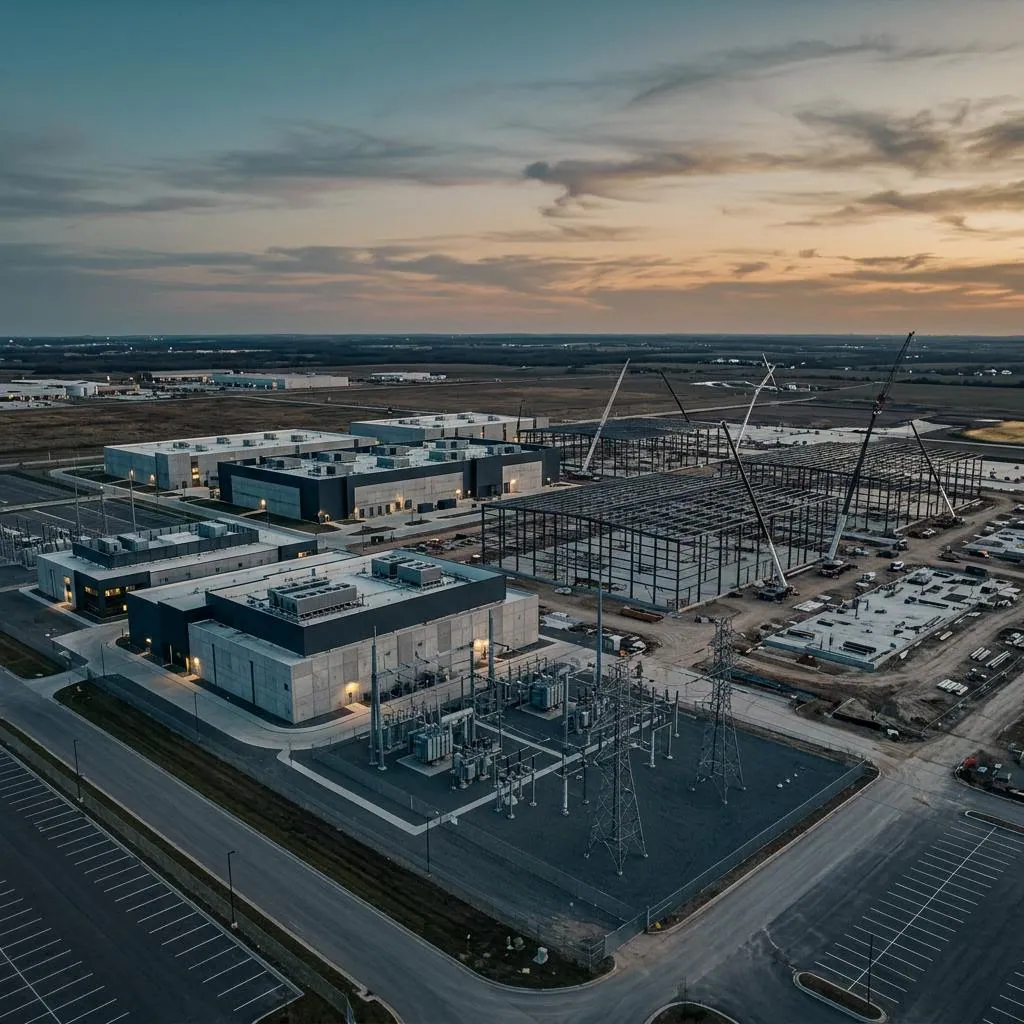
This article presents economic scenarios and dated reporting, not a forecast that a recession or financial crisis is inevitable. The banner is an AI-generated editorial illustration, not a photograph of a named project. Sources are linked beside the claims they support; company statements are identified as such.