AI in Cybersecurity: The Automated Red Teamer
 Lorenzo Vallone
Introduction
The cybersecurity landscape of 2026 is defined by a single, terrifying asymmetry: Attackers only need to be right once; defenders need to be right every time. For decades, this math favored the hacker. But this year, the equation has shifted.
We have entered the era of Automated Red Teaming.
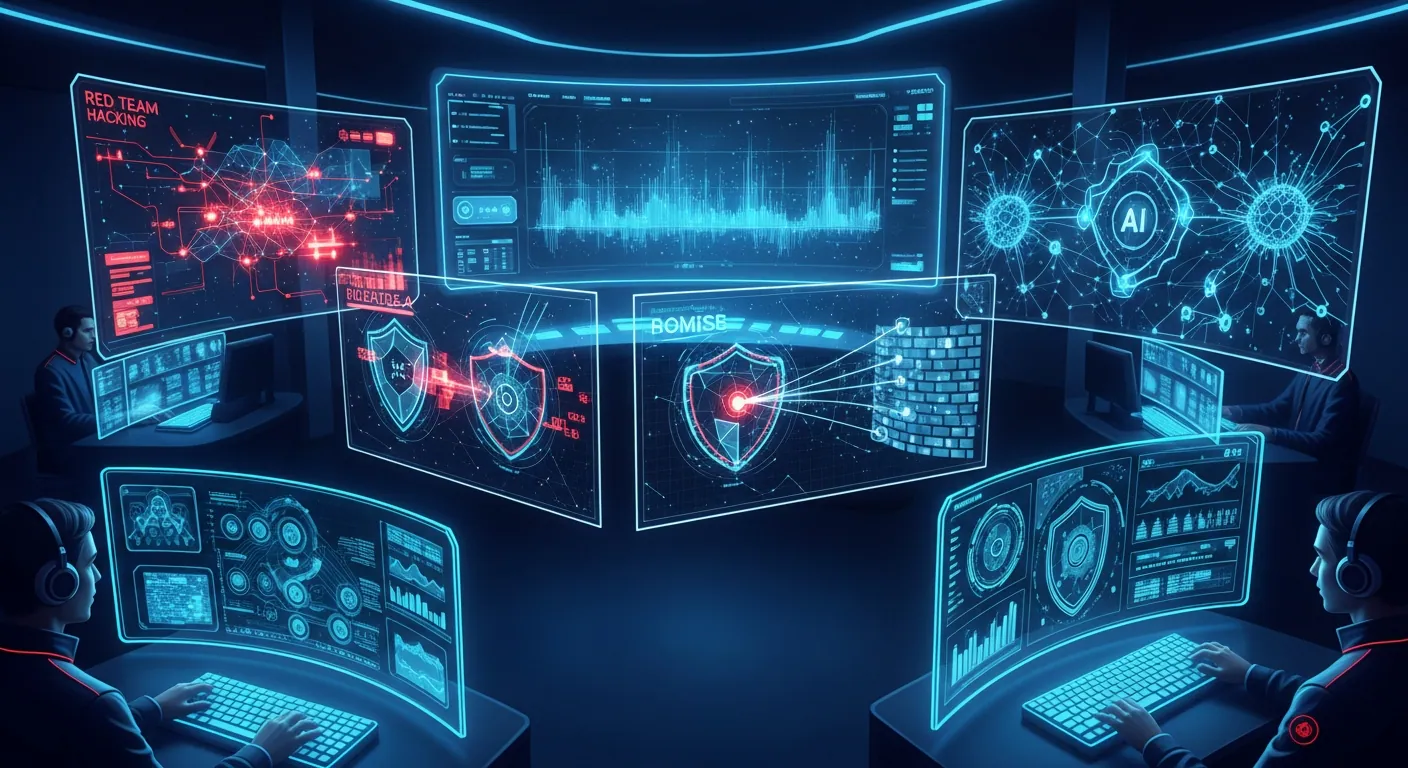
Traditionally, "Red Teaming" (ethical hacking) was a manual, expensive process. A company would hire a firm to break into their network once a year. It was a snapshot in time. Today, AI-driven Red Teams attack your own network 24/7, relentlessly probing for weaknesses with the same sophistication as a nation-state actor, but without the malicious intent. This shift from "Annual Audit" to "Continuous Adversarial Simulation" is the most significant change in security posture in a decade.
The Offensive AI: Polymorphic Malware
To understand the defense, we must understand the threat. Attackers are now using Large Language Models (LLMs) to write Polymorphic Malware.
In the past, antivirus software worked by looking for "signatures"—specific lines of code known to be bad. If a hacker changed the code, the signature wouldn't match. In 2026, hackers use AI to rewrite the entire codebase of a virus every time it infects a new machine. The function remains the same (steal data), but the code structure looks completely unique.
This has rendered traditional "signature-based" detection obsolete. You cannot blacklist a file hash that has never existed before.
The Defensive Response: AI SOC Analysts
The industry's answer is the Autonomous SOC (Security Operations Center).
Tools like CrowdStrike Charlotte AI and Palo Alto Networks Precision AI act as force multipliers. In 2024, a human analyst might spend 4 hours investigating a suspicious login. In 2026, the AI investigates it in seconds.
The AI pulls the IP address, cross-references it with threat intelligence feeds, checks the user's typical behavior patterns (User and Entity Behavior Analytics - UEBA), and determines if the login is malicious. If it is, the AI isolates the laptop from the network instantly. This "Machine-Speed Response" is the only way to combat "Machine-Speed Attacks."
The Benchmark: DARPA AIxCC
The turning point for this technology was the DARPA AI Cyber Challenge (AIxCC).
In late 2025, DARPA crowned its winner: Team Atlanta (a collaboration including Georgia Tech and Samsung Research). Their system, "Atlantis," demonstrated the ability to autonomously find and patch vulnerabilities in open-source software.
Crucially, these systems don't just find the bug; they write the code to fix it. This concept of "Self-Healing Software"—where an operating system detects a breach and rewrites its own kernel to close the hole in real-time—is no longer science fiction. It is the new standard for critical infrastructure.
The Identity Crisis: Deepfake Social Engineering
While code security is improving, "Human Security" is collapsing.
The rise of real-time voice and video deepfakes means you can no longer trust your eyes or ears. In 2026, "CEO Fraud" involves a video call where your boss looks and sounds exactly like your boss, asking you to wire funds.
This has led to the adoption of "Liveness Detection" and "Zero Trust Identity" frameworks. Companies are moving away from passwords and even 2FA (Two-Factor Authentication) toward "Passkeys" and biometric behavior analysis (how fast you type, how you hold your phone) to verify identity.
Conclusion
AI has weaponized the internet, but it has also armored it. The winner of the cybersecurity war in 2026 will not be the side with the best hackers, but the side with the best autonomous agents.
Related Resources
Explore the tools mentioned in this article:
- CrowdStrike - AI-powered cybersecurity platform