AI Is Our Next Fire: Power, Risk, and the Responsibility to Learn
 Lorenzo Vallone
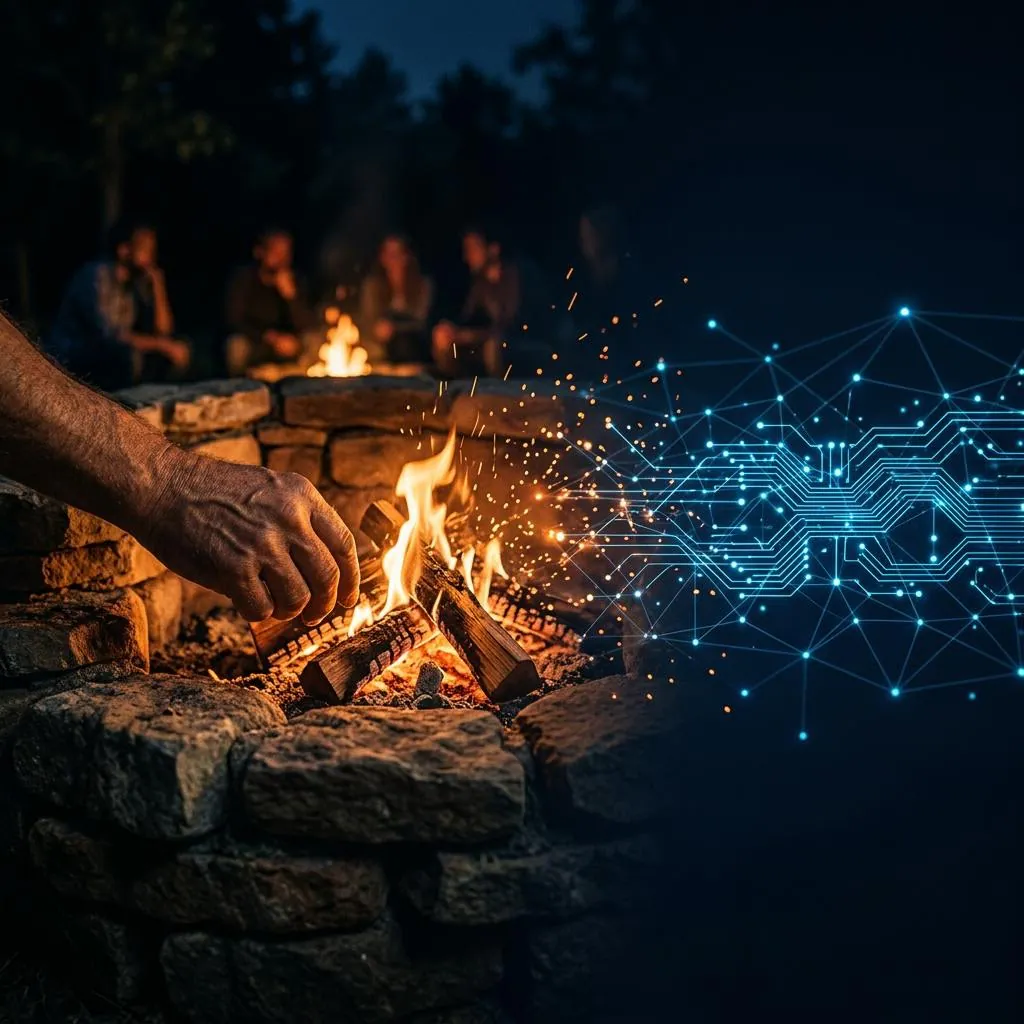
Before fire became a tool, it was a threat.
It arrived through lightning, swept across landscapes, and destroyed what stood in its path. Our ancestors did not invent combustion. They learned something more consequential: how to capture it, sustain it, and put it to work.
The same force that could burn a shelter could warm it. The same heat that could injure a person could cook their food. Eventually, controlled fire would help people turn clay into pottery and ore into metal.
I believe artificial intelligence deserves to be considered in that same category of change: not because it works like fire, but because it expands what human beings can do—and makes our judgment about how to use it more consequential.
In skilled and conscientious hands, AI can accelerate discovery and improve lives. In untrained hands, it can cause damage without anyone intending harm. In malicious hands, it can make deliberate harm easier to scale.
Those possibilities are not competing descriptions. They are all true.
What fire actually changed
There was no single documented “discovery of fire” followed by an immediate leap into civilization. Learning to use it was a long, uneven process, and evidence of burning is not automatically evidence that people could reliably start fires whenever they wanted.
At South Africa's Wonderwerk Cave, researchers identified burned bone and ashed plant material in deposits approximately one million years old, providing strong evidence of fire associated with early humans. The same PNAS study distinguishes that early evidence from the much more extensive archaeological record of fire use within the past 400,000 years.
What followed was not one benefit but a series of capabilities that reinforced one another.
Cooking changed food. Heat can make some foods easier to chew and digest, improve access to nutrients, and reduce many foodborne hazards when used correctly. A meal became something people could transform, not simply collect.
A small modern experiment offers a measurable illustration. In a study of five ileostomy patients, researchers measured egg-protein digestibility at approximately 91% when cooked, compared with 51% when raw. That is a result for a particular food and patient group—not a universal percentage for cooking, nor a measurement of prehistoric diets. But it demonstrates how substantially heat can change the nutritional value we can extract from food.
Heat changed the conditions of survival. Fire helped people cope with cold and made more environments usable. It did not eliminate exposure, but it gave people a way to modify their immediate surroundings.
Light changed the usable day. A hearth provided illumination after sunset and a place to gather. Darkness no longer imposed quite the same limits on shared activity.
High-temperature craft changed materials. Much later, increasingly sophisticated control of heat enabled ceramics, metal smelting, and forging. The cooking fire did not immediately produce the metalworking furnace. Each advance required additional knowledge, tools, and accumulated practice.
That sequence matters. Fire's greatest contribution was not simply that it performed a task. It enabled people to develop other technologies.
Human growth: the numbers—and the limits
The connection between fire and human development is important enough to describe accurately.
The Smithsonian's Human Origins Program reports that brain size tripled over the course of human evolution, with particularly rapid growth between approximately 800,000 and 200,000 years ago. Its account places those changes within a wider history of environmental challenges, body-size changes, and social adaptation. The Smithsonian's overview does not attribute that tripling to fire alone.
The “cooking hypothesis” proposes that easier access to food energy helped support the evolution of larger brains. It is an influential explanation, but the timing and causal relationship remain debated. A 2016 study challenging the hypothesis argues that cooking is neither necessary nor sufficient to explain hominin brain expansion.
There is also no reliable global before-and-after population count that lets us say, “Fire increased humanity by this percentage.” Its adoption predates written records by an enormous span, and climate, migration, diet, cooperation, and later agriculture all complicate the story.
The defensible claim is that controlling fire helped expand human capabilities and conditions for survival—not that one discovery single-handedly caused a quantified population explosion or tripled our brains.
That is a stronger foundation for the AI comparison. Transformative technologies interact with people, institutions, and other inventions. They do not create progress in isolation.
AI is spreading on a very different clock
Fire knowledge moved through communities over generations. AI capabilities can now be delivered through software to large populations in a matter of months.
AI itself is not new; it draws on decades of research. What changed with the recent generative-AI wave was public access. People could begin asking questions, writing code, generating images, and analyzing documents through ordinary language.
The speed is measurable.
In nationally representative U.S. surveys, researchers found that by late 2024, nearly 40% of adults ages 18–64 were using generative AI. Among employed respondents, 23% had used it for work during the previous week, and 9% used it every workday. Relative to the first mass-market launch of each technology, overall adoption was faster than that of either personal computers or the internet. These are findings from the February 2025 version of The Rapid Adoption of Generative AI, not a count of everyone using AI today.
More recently, Stanford's 2026 AI Index economy chapter reports that 88% of surveyed organizations used AI in 2025, compared with 55% in 2023—a rise of 33 percentage points in two years. It separately reports generative-AI use in at least one business function at 70% of organizations.
These measures describe different populations and definitions. Trying a chatbot, using AI weekly, and integrating it reliably into a business are not the same thing.
Still, the direction is clear: access is expanding faster than the habits, training, and governance needed to use it well.
That is the central tension of this moment.
The opportunity: accelerate the work of discovery
Fire let humans transform materials beyond what their hands and teeth could accomplish alone. AI can help us work with information at a scale and speed that unaided individuals cannot.
For a researcher, that can mean identifying candidate molecules or searching a complex body of literature. For an engineer, it can mean generating designs and testing alternatives. For a teacher, it can mean adapting explanations. For a small business, it can mean building tools that once required resources it could not afford.
The potential is not limited to producing more content. It includes reducing the time between a useful question and a testable answer.
Consider protein research. In July 2022, DeepMind and EMBL-EBI expanded the AlphaFold database to more than 200 million predicted protein structures, approximately a 200-fold expansion from nearly one million. The EMBL-EBI announcement describes making those predictions freely available to researchers.
Those are predictions, not 200 million experimentally confirmed structures or newly discovered medicines. Scientists still need to assess confidence, investigate biological function, and conduct experiments. But providing such a large collection of starting points changes what researchers can explore.
That is the opportunity I find most compelling: AI can help more people participate in discovery, while helping specialists investigate more possibilities.
The combination we should pursue is not artificial intelligence instead of human expertise. It is artificial intelligence used by people who know how to question, test, and apply its output.
The danger is not only bad intentions
We do not need to imagine a malicious user to understand how AI can cause harm.
A well-intentioned employee can expose confidential information by putting it into an unsuitable tool. A manager can deploy a biased screening system without recognizing whom it excludes. A professional can mistake a convincing answer for a verified fact. An automated agent can execute an incorrect instruction across hundreds of records before anyone notices.
Good intentions do not substitute for competence.
Nor does competence guarantee good intentions. Skilled attackers can use AI to support impersonation, fraud, manipulation, and cyber abuse. Systems connected to physical equipment introduce additional safety concerns because a mistaken action may affect people and property, not just a document.
The warning signs are already measurable. Stanford's 2026 AI Index reports 362 documented AI incidents in 2025, up from 233 in 2024—approximately a 55% increase. These are recorded incidents, not a complete census of harm; changes in reporting and awareness can influence the totals.
There is an important difference from fire, too. A flame is visibly hot. An AI error can arrive as polished prose, plausible code, or an apparently reasonable recommendation. Fluency can hide uncertainty.
And unlike a single hearth, an AI system can be connected to global distribution, private data, financial permissions, or machines. Its potential consequences depend not only on what it says, but on what it is allowed to do.
Skill and conscience are necessary. Systems are necessary too.
Learning to use fire did not make every person a master metalworker. Learning to use AI should not require everyone to become a machine-learning researcher.
But everyone needs an appropriate level of literacy: what the tool can do, where it fails, what information it may receive, and when its output needs independent verification.
For organizations, that literacy must be supported by practical controls:
- Train people for the actual task. Teach source checking, uncertainty, privacy, and escalation—not just how to write prompts.
- Match permissions to consequences. An assistant drafting a message should not automatically have authority to send it, spend money, delete records, or control equipment.
- Test before scaling. Evaluate realistic failure cases, biased outcomes, adversarial inputs, and performance on the people and situations the system will encounter.
- Make human review meaningful. Give reviewers the expertise, evidence, time, and authority to challenge a system. A rushed approval click is not effective oversight.
- Plan for failure. Use monitoring, logs, incident reporting, rollback procedures, and tested ways to stop or isolate a system. A stop mechanism must be engineered, not assumed.
- Assign accountability. Identify who owns deployment decisions, investigates harm, and provides a remedy when people are affected.
The NIST Generative AI Risk Management Profile provides a practical starting point for managing risks across the AI lifecycle. No framework guarantees safety, but disciplined evaluation is more credible than a promise to “use AI responsibly.”
Society needs corresponding safeguards: research into safety, enforceable protections against abuse, independent scrutiny proportionate to risk, international cooperation, and meaningful public participation.
Responsibility cannot sit only with the person typing into a chat box. Developers, deployers, employers, and governments all make decisions that shape the risks.
We cannot make the discovery disappear
Humanity cannot collectively forget how to use fire. Nor is it realistic to expect that we can erase the knowledge and widely distributed methods behind modern AI.
That does not mean every system must be released, every deployment must proceed, or every use deserves permission. We can restrict dangerous applications, require stronger evidence in high-stakes settings, and stop systems that cannot be operated acceptably.
The knowledge is durable. Permission to use it without limits is not inevitable.
That distinction gives us a useful alternative to both reckless acceleration and blanket rejection.
We should expand beneficial access and education while placing stronger controls where the potential harm is greater. We should measure outcomes, not just celebrate capability. And we should make sure the benefits reach beyond those who already control the most resources.
The next responsibility
Fire was among the most consequential forces humans learned to harness. It nourished us, warmed us, illuminated our surroundings, and eventually helped us reshape the material world.
It also burned homes, devastated communities, and became a weapon.
The destructive potential did not cancel the benefits. The benefits did not excuse the destruction. We learned—and are still learning—to combine knowledge with safeguards.
AI deserves the same seriousness.
I am optimistic about what it can help us discover and create. But optimism should make us more willing to invest in skill, accountability, and safety, not less.
We have acquired a powerful new capability. Our responsibility, as a species, is to learn how to use it for good—and to build ways to prevent and contain the harm when ignorance, failure, or malice puts it to destructive use.
We cannot undiscover the fire. We can decide how responsibly we tend it.
By Lorenzo Vallone, ARTE LOGICA. Research checked October 27, 2026. Historical evidence, survey populations, and reporting years are identified above; the comparison between fire and AI is an editorial analogy, not a claim that their mechanisms or timelines are equivalent. Hero artwork is AI-generated.