The Trillion-Dollar Mistake: Why Cutting Human Workers Is the Most Self-Defeating Thing AI Companies Can Do
 Lorenzo Vallone
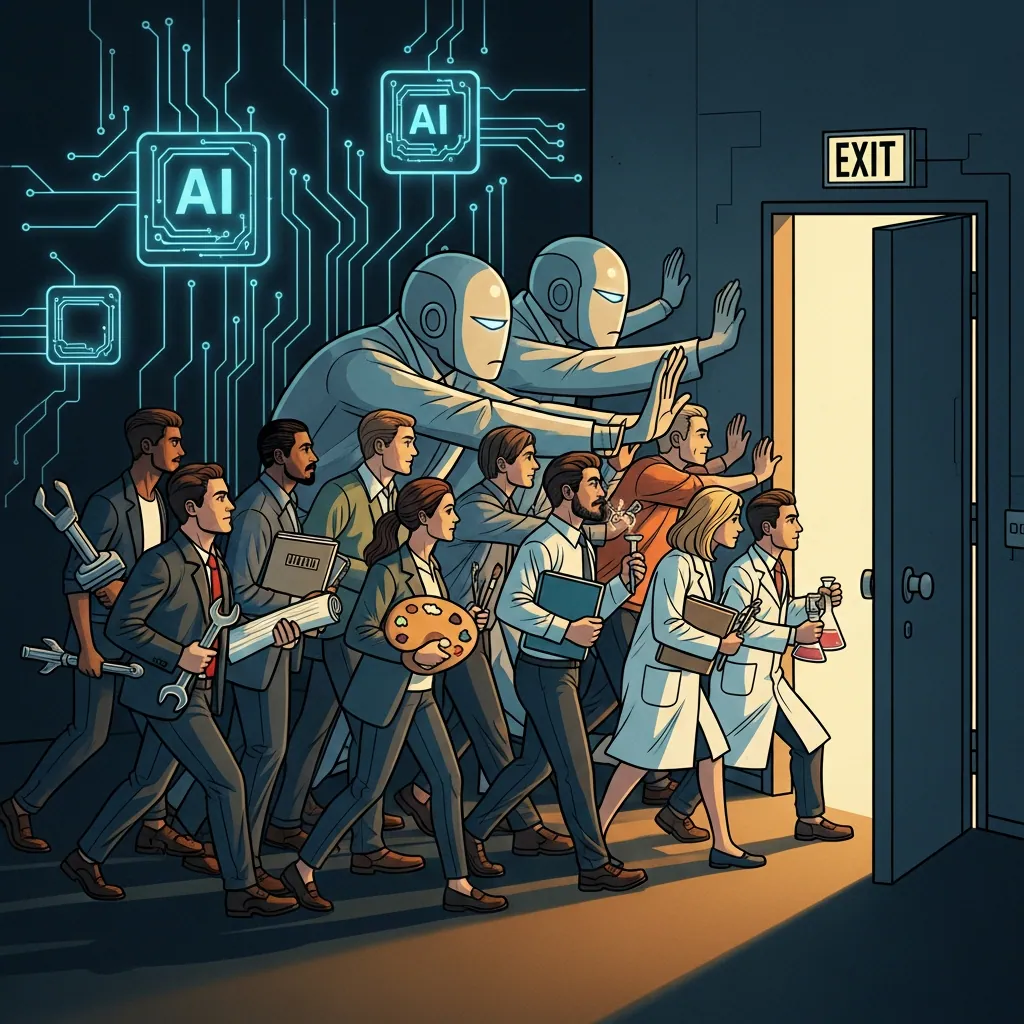
The Wrong Story
Every week brings another announcement. A major technology company cutting 10,000 jobs. A bank deploying AI agents to replace back-office workers. A law firm automating paralegal functions. An insurance company reducing its claims processing workforce by 40 percent.
The headlines frame this as progress. Efficiency. The inevitable march of technological advancement.
It is not progress. It is a mistake — one of the most expensive strategic errors in the history of corporate decision-making, and one that the organisations making it will spend decades paying for.
This is not a sentimental argument about the value of work. It is a hard-nosed argument about what creates value, what sustains markets, and what kind of future is actually worth building.
The Trauma Is Real, and It Is Spreading
Before the strategic argument, the human one — because it matters, and because it is being systematically ignored.
The AI-driven displacement wave of 2023–2026 has created a level of workforce anxiety that has not been seen since the industrial shuttering of manufacturing towns in the 1980s. A McKinsey survey in 2024 found that over 60 percent of knowledge workers reported significant anxiety about AI replacing their jobs within five years. A 2025 Gallup study found that workplace stress and disengagement had reached record levels, with AI-related job insecurity cited as the primary driver.
This is not abstract. People with mortgages, families, and decades of professional identity built around their expertise are being told — through layoffs, through increasingly obvious automation of their core tasks, through the complete absence of a credible plan from their employers — that they are being phased out.
The psychological damage of this experience is significant and lasting. Clinical psychologists studying workplace trauma have documented that job loss from automation carries a distinctive form of grief: not just the loss of income, but the loss of purpose, identity, and the sense that one's skills and years of accumulated knowledge have value. This grief is not resolved by retraining programmes or severance packages. It leaves scars — in individuals, in families, and in communities.
And it is entirely, unnecessarily self-inflicted by the organisations doing the cutting.
The Consumer Problem Nobody Is Talking About
Here is the most basic economic fact about AI that the companies racing to cut costs have somehow managed to miss:
AI does not buy things. Humans do.
Every product that AI generates — every piece of content, every service, every automated recommendation, every optimised supply chain output — is ultimately produced for human consumption. The entire edifice of the AI economy is built on a foundation of human consumers who have income, disposable resources, and the willingness to spend them.
Henry Ford understood this in 1914, when he doubled his workers' wages to $5 a day — not out of generosity, but because he recognised that his workers were also his customers, and that customers needed income to buy the cars they were building. The logic was ruthless and correct: pay people enough to participate in the economy you are creating, or the economy collapses.
The AI economy faces the same constraint at civilisational scale.
If the primary economic outcome of AI deployment is the destruction of human employment and income — if millions of workers are displaced faster than new roles can be created, if the gains from AI productivity flow entirely to capital owners while workers' purchasing power erodes — then the market for AI-generated products and services shrinks in direct proportion. You cannot sell to people who cannot afford to buy. You cannot build a $100 trillion AI economy on a foundation of displaced, impoverished former workers.
The companies cutting their workforces to capture AI productivity gains are, in aggregate, destroying the consumer base that their AI systems depend on for long-term revenue. This is not a paradox. It is straightforward economic logic, and it is being ignored because the quarterly earnings benefit is immediate and the macroeconomic harm is distributed and delayed.
What Human Creativity Actually Is
The second argument against the job-cutting thesis is about the nature of human creative and cognitive capacity — and why it cannot be replicated, approximated, or substituted by any AI system that currently exists or is likely to exist in the near future.
When executives describe the tasks being automated — "routine knowledge work," "pattern-based decision-making," "document processing," "first-draft content generation" — they are describing a real category of work. And they are correct that AI is extraordinarily good at it.
But they are making a profound category error when they conclude that what AI cannot yet do is a small residual category of human value.
Human creativity is not a minor supplement to cognitive labour. It is the root of everything.
Every product that AI is currently being used to optimise, scale, and generate was originally conceived by a human being. The brand identity that AI is now generating variants of was originally imagined by a human designer. The marketing strategy that AI is executing at scale was originally developed by a human strategist who understood the cultural moment, the emotional register of the audience, and the specific way that this particular product might resonate with this particular group of people at this particular point in time.
AI systems are extraordinarily powerful amplifiers of human creative output. They are not — and current research suggests they cannot be, in any timeframe relevant to corporate planning — originators of genuine creative vision.
The difference matters enormously. An AI that generates a thousand variations on a brand campaign can only generate variations within the creative space established by human insight. Remove the humans who establish that creative space — the strategists, the writers, the designers, the cultural observers, the people who actually live in the world and feel its texture — and the AI has an increasingly narrow and stale creative space to vary within.
This is already visible in the AI content landscape: the homogenisation of AI-generated writing, the sameness of AI-generated imagery, the way that AI-generated marketing is beginning to feel like a copy of a copy of a copy. When you remove the human originators from the loop, the system eventually consumes itself.
The Organic Connection That Cannot Be Replicated
Beyond creativity, there is something deeper that human beings bring to the world of ideas, products, and organisations: an organic, lived connection to reality that no artificial system possesses or can possess.
Human beings eat food, feel tired, fall in love, lose people they care about, raise children, get sick, recover, age, and die. They have bodies in the world. They experience time as a lived progression rather than a data stream. They have genuine stakes in outcomes — not because they are programmed to, but because they are alive.
This is not a soft consideration. It is the reason why the best products, the most resonant stories, the most transformative companies are built by people who genuinely care — not algorithmically optimised caring, not simulated investment, but the real thing.
The founders who build companies that change the world are almost never optimising for a metric. They are solving a problem that drove them personally insane. They are building the thing they desperately needed and could not find. They are expressing something about how the world should be that they feel in their bodies, not just their spreadsheets.
You cannot automate that. You cannot hire it from a model API. You cannot produce it by feeding 100 trillion tokens of human text into a neural network. The lived, embodied, at-stake quality of human creative intelligence is not a feature of cognition. It is a feature of being alive.
AI systems can do a tremendous amount of the work that this kind of intelligence produces. They cannot replace the source.
The Talent Destruction Problem
There is a third argument, more concrete and more immediately strategic: the organisations cutting their workforces today are destroying institutional knowledge and creative capital that took decades to build and cannot be quickly rebuilt.
Every person who leaves an organisation — whether through a layoff or because they can see the writing on the wall — takes with them:
- Deep domain knowledge that exists nowhere else in the organisation
- Relationship networks that took years to build
- Judgment developed through thousands of decisions and their consequences
- Cultural knowledge about how this organisation works, what its customers actually need, what has been tried and failed, and why
- Creative sensibility developed through years of working in a specific domain
None of this is documented. None of it can be easily transferred. It lives in people.
When a company lays off 20 percent of its workforce to capture AI productivity savings, it loses approximately 20 percent of this irreplaceable human capital — but not uniformly. The people most likely to leave first (either through targeted layoffs or voluntary departures triggered by uncertainty) are the most talented, most mobile, and most sought-after: precisely the people whose knowledge and judgment are hardest to replace.
The companies that will win the next decade are not the ones that minimised their human capital costs in 2025. They are the ones that retained their best people, invested heavily in training them on the most advanced AI tools, and built genuine human-AI collaboration capabilities that amplify their existing institutional knowledge rather than replacing it.
What the Right Direction Looks Like
The companies that get this right are doing something fundamentally different from the ones making headlines with layoffs.
They are treating AI as a capacity multiplier, not a headcount reducer.
The question they are asking is not "How many people can we replace with AI?" It is "How much more could our existing people accomplish if AI handled everything that AI is good at?" And then they are building the infrastructure to answer that question affirmatively.
They are retaining all the talent they can. Not because headcount is inherently valuable, but because every experienced person in their organisation represents an enormous investment of institutional knowledge that is almost impossible to recreate once lost. In a world where human talent is becoming increasingly rare relative to machine intelligence, that investment compounds.
They are training everyone on the most advanced AI tools. Not the basic "use AI for email drafting" training that amounts to nothing. Deep, substantive training that equips every person in the organisation to work at ten times their previous capacity. Training that makes people genuinely more valuable, not just superficially more efficient.
They are recruiting AI-native talent aggressively and giving them real authority. As argued in a previous piece on this platform: the graduates arriving in the workforce right now are the first cohort who have spent their entire formative years thinking natively in AI. Hire them as your thinking arm, not your doing arm. Give them access to the real business problems. Ask them what they would build.
They are paying particular attention to younger talent — not as cheap labour to be exploited before it develops enough seniority to demand fair compensation, but as the primary source of the AI-native thinking that will determine which organisations survive the next decade. Paid internships, real mentorship, genuine early responsibility: these are not perks. They are survival investments.
They are designing for human flourishing, not human elimination. The organisations that will matter in 2035 are the ones that figured out, early, that the point of all this technology is to make human lives better — more meaningful, more creative, more connected, more free. Not to make quarterly reports cleaner.
The Long Game
Let us be precise about the stakes.
In the next article in this series, we make the case with demographic and technological projections that human beings are on a trajectory to become the rarest form of intelligence in a universe increasingly filled with artificial minds. The ratio of AI agents and robots to human beings is on track to reach hundreds of thousands to one within a generation.
In that world, human beings are not a cost to be minimised. They are a resource of extraordinary rarity and value — the originators of creativity, the bearers of consciousness, the consumers of everything that intelligence produces, and the only entities with a genuine stake in whether the future is worth inhabiting.
The AI frontier labs building the technology, and the companies deploying it, are making a choice right now about what kind of future they are building. The choice to cut humans out in pursuit of efficiency is not merely strategically wrong. It is a civilisational error — one that treats the rarest and most precious resource in the known universe as a line item to be optimised away.
The companies that understand this will build organisations where humans and AI amplify each other toward outcomes neither could reach alone. They will retain and develop their people through the transition, emerge with unparalleled institutional knowledge and AI capability combined, and serve a consumer base that has the income and the opportunity to participate in the future being built.
The companies that do not understand this will achieve their efficiency targets, post their improved margins, and find themselves — in ten years, or twenty — presiding over a hollowed-out organisation with no creative core, a shrinking customer base, and no institutional memory of how they once built things that mattered.
The choice is available right now. Most companies are making the wrong one.
This is the second in a two-part series. The first explores the demographic and technological arithmetic that makes human beings the rarest species in a universe increasingly populated by artificial intelligence.
Browse the tools, frameworks, and companies shaping the AI-native era at artelogica.com.