The Battle of the "Reasoning" Models: o1 vs. Gemini 1.5 vs. Claude 3.5
 Lorenzo Vallone
Introduction
For the first few years of the Generative AI boom, the metric that mattered most was "vibes." How natural did the text sound? How creative was the poem? But as we entered the mid-2020s, the enterprise demand shifted from creativity to reliability. Companies didn't need a chatbot that could write a sonnet; they needed one that could architect a database schema without hallucinating non-existent keys.
This shift gave birth to the Reasoning Models. Unlike standard Large Language Models (LLMs) that predict the next word based on probability, reasoning models utilize a "Chain of Thought" (CoT) process. They "think" before they speak, generating internal tokens to verify their logic before outputting a final answer.
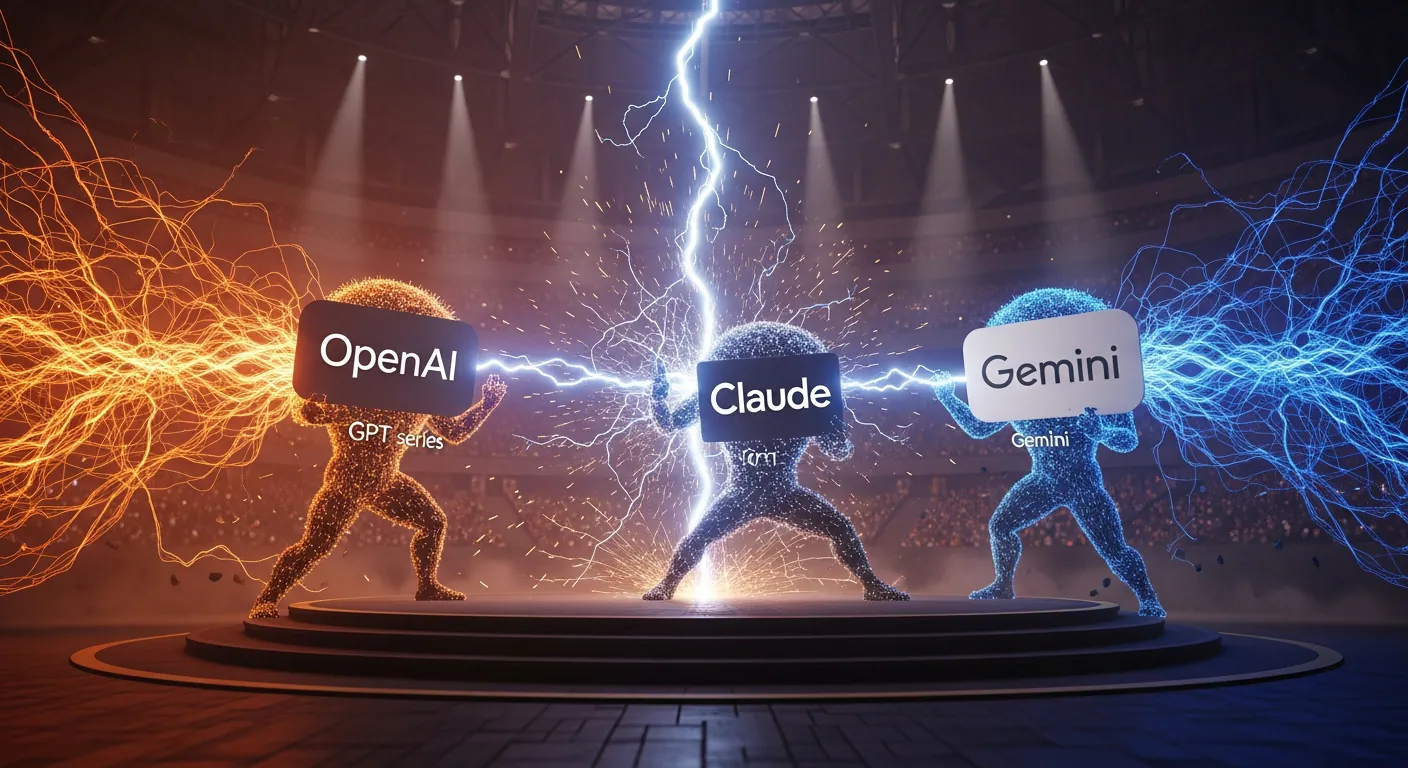
In 2026, three titans stand atop this hill: OpenAI's o1, Google's Gemini 1.5 Pro, and Anthropic's Claude 3.5 Sonnet.
OpenAI o1: The Deep Thinker
OpenAI's o1 (and its faster sibling, o1-mini) represents a paradigm shift. It was trained using reinforcement learning specifically to excel at complex, multi-step problems in math and coding.
When you ask o1 a difficult question, you will notice a pause—sometimes lasting 10 to 30 seconds—while it "thinks." During this time, the model is exploring different problem-solving paths, rejecting dead ends, and double-checking its work.
Best Use Case: Complex Architecture & Math. If you need to solve a competitive programming problem (like those found on LeetCode) or design a complex microservices architecture where race conditions are a risk, o1 is currently the king. It excels at spotting logical inconsistencies that other models gloss over.
Google Gemini 1.5 Pro: The Context King
While OpenAI focused on "depth" of thought, Google focused on "width." Gemini 1.5 Pro features a staggering 2 million token context window.
To put that in perspective, you can upload the entire codebase of a mid-sized startup, or a PDF of a 5,000-page legal discovery document, and Gemini can hold the entire thing in its "working memory" at once. It doesn't need to summarize or fragment the data.
Best Use Case: Massive Data Retrieval & QA. If you want to ask, "Is there any function in this 50-file codebase that updates the user balance without a database transaction lock?", Gemini is the tool for the job. Its "needle-in-a-haystack" retrieval capabilities allow it to reason across vast amounts of disconnected information better than any competitor.
Anthropic Claude 3.5 Sonnet: The Developer's Sweet Spot
Anthropic has carved out a unique niche with Claude 3.5 Sonnet. While it may not have the massive context of Gemini or the raw reinforcement learning depth of o1, it is widely considered the most "human" and capable coder for day-to-day tasks.
Claude 3.5 Sonnet strikes a balance between speed and reasoning. It doesn't pause for 30 seconds like o1, but it follows instructions with a nuance that GPT-4 often misses. It has become the default model for many automated coding agents (like the aforementioned Windsurf and Cursor) because it produces cleaner, more idiomatic code with fewer bugs.
Best Use Case: Frontend Development & Nuanced Writing. Claude excels at generating UI code (React/Tailwind) that actually looks good on the first try. It also tends to be less "lazy" than GPT models, often writing out full files rather than leaving comments like // ... rest of code here.
The Benchmark War
Comparing these models requires looking at specific benchmarks:
- SWE-bench (Software Engineering): This benchmark tests an AI's ability to resolve real GitHub issues. As of early 2026, Claude 3.5 Sonnet and OpenAI o1 trade blows for the top spot, solving roughly 40-50% of verified issues—a massive leap from the 3% success rate of GPT-4 in 2023.
- MATH (High School/College Math): OpenAI o1 dominates here, often scoring above 90%, behaving more like a logic engine than a language model.
- Needle In A Haystack (Retrieval): Gemini 1.5 Pro maintains a near 100% recall rate even at 2M tokens, a feat the others struggle to match at that scale.
Conclusion
The "best" model in 2026 depends entirely on your domain:
- Use OpenAI o1 for heavy logic, math, and complex system design where latency doesn't matter.
- Use Gemini 1.5 Pro when you have massive documents or codebases to analyze.
- Use Claude 3.5 Sonnet for daily coding, writing, and tasks requiring high emotional or stylistic nuance.
Related Resources
Explore the tools mentioned in this article:
- OpenAI GPT-4 - Advanced language model for reasoning and coding
- Google Gemini - Multimodal AI with massive context window
- Anthropic Claude - Developer-focused AI assistant