From Prompts to Portals: How Gemini Canvas Is Redefining 3D Experiences
 Lorenzo Vallone
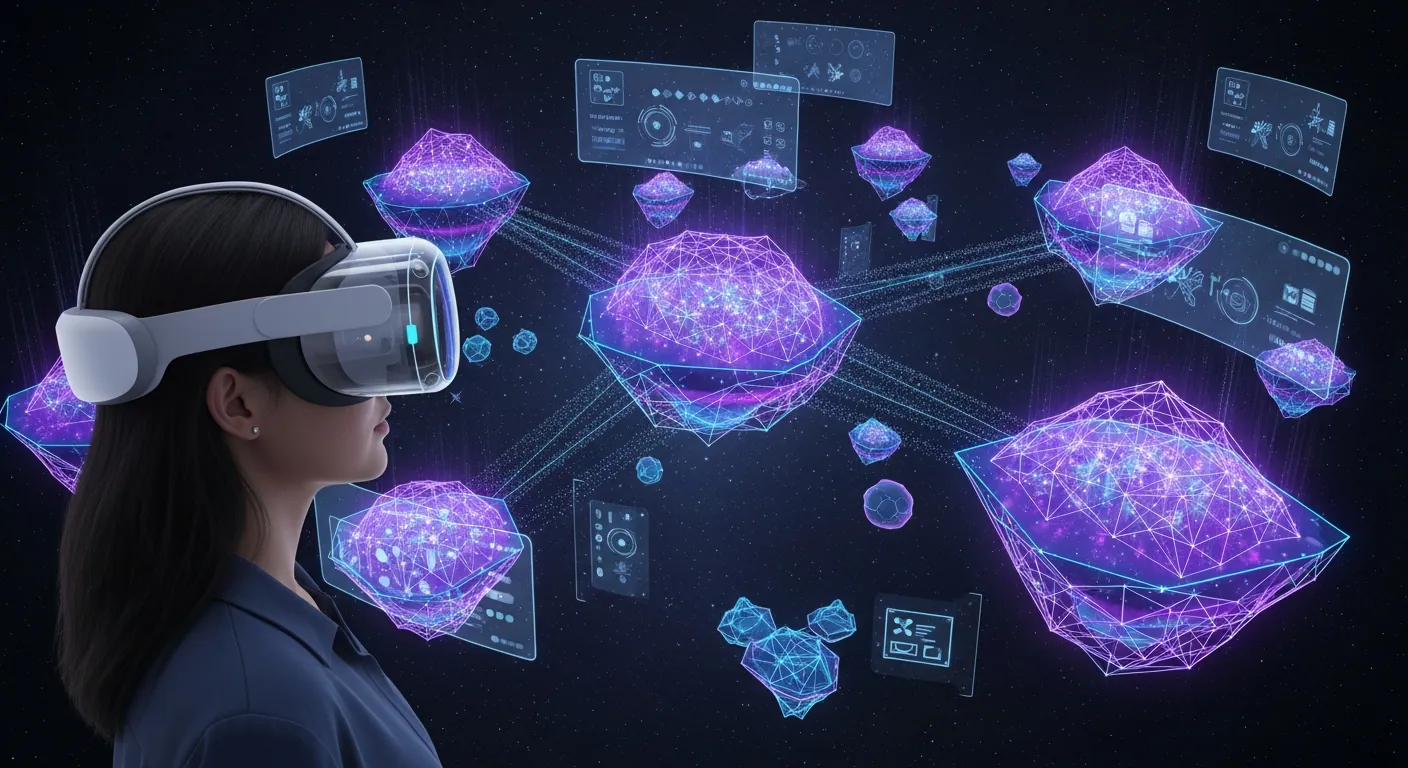
Google recently unveiled a breakthrough that could reshape how we think about building immersive digital experiences. In a detailed post on the Google Developers Blog, the Android XR team introduced a workflow that allows creators to turn simple text prompts into fully interactive extended reality (XR) experiences using Gemini Canvas. The implications are enormous — not just for XR developers, but for anyone working at the intersection of AI and spatial computing. At ARTE LOGICA, we have been following these developments closely because we believe interactive 3D experiences are the future of how people discover and engage with information.
The core idea behind Google's approach is elegant in its simplicity. Rather than requiring months of 3D modeling, shader programming, and environment design, developers can now describe what they want in natural language and watch Gemini bring it to life. Want a pen that draws rainbows in three-dimensional space? Just ask. Need a planetarium that renders real star data around you? Describe it. The system leverages Gemini 2.5 Pro and its Canvas feature to generate interactive WebGL and Three.js scenes directly from conversational prompts, then deploys them onto devices like the Samsung Galaxy XR headset through WebXR APIs.
What makes this particularly exciting is the accessibility factor. Traditional XR development has always been the domain of specialized teams with deep expertise in graphics programming, spatial audio, physics engines, and device-specific APIs. Google's workflow collapses that barrier. A designer with no coding background can prototype an interactive AR experience in minutes. A teacher can create an immersive biology lesson where students walk through a bloodstream rendered with realistic WebGL graphics. The examples Google shares — from origami birds that land on your hand to cat-themed arcade games — demonstrate that the ceiling for creativity is as high as your imagination allows.
But what caught our attention most was the underlying technology stack. Gemini Canvas generates Three.js code — the same open-source 3D library that powers countless web-based 3D experiences across the internet. This is not a proprietary black box. The generated experiences run in Chrome, use standard WebXR APIs, and can be inspected, modified, and extended by developers who want to push beyond what the AI initially produces. Google even describes how developers can set up an "XR Gem" with an ultra-prompt that gives Gemini advanced perception capabilities, enabling realistic AR physics and AI-generated textures that make 3D objects look polished and professional.
This matters because it validates a direction we have been exploring at ARTE LOGICA. When we built our 3D Explore Gallery — available right now at artelogica.com/explore — we wanted to create something that goes beyond a traditional resource directory. Instead of scrolling through flat lists and card grids, visitors enter an immersive space-themed environment where AI resources are organized as floating islands, each representing a different category of artificial intelligence. Large Language Models, AI Agents, Machine Learning, Generative AI, Robotics, Full Self-Driving, and more — each category has its own unique island shape rendered in real-time 3D using Three.js and WebGL.
The experience is designed to feel like stepping into a living map of the AI landscape. You can orbit the camera around the scene, zoom in on individual islands, and click to explore the resources orbiting each one. Resource cards float in space, connected by curved bezier lines to their parent islands. Holographic hover effects highlight resources as you interact with them, and a popup card appears with details, descriptions, and direct links when you select a resource. The entire experience runs in your browser — no downloads, no plugins, no headset required.
We built ARTE LOGICA's 3D Explore page using raw Three.js rather than a framework abstraction, giving us precise control over the scene graph, camera animation, lighting, and interaction model. Each of the twelve category islands has a distinct geometric shape — crystals for LLM, layered formations for Agents, spheres for Machine Learning, organic shapes for Generative AI, mechanical structures for Automation, flowing forms for Data and Analytics, and specialized shapes for Content, Marketing, Software Development, Robotics, Full Self-Driving, and our unique Claw Bots category. The islands are color-coded and arranged in a grid sorted by resource count, making it immediately clear which areas of AI have the richest collection of tools and resources.
What Google's announcement reinforces is that this kind of spatial, interactive presentation is not a novelty — it is the direction the entire industry is heading. As XR hardware becomes mainstream and AI tools make 3D content creation accessible to everyone, the gap between a flat webpage and an immersive spatial experience will shrink rapidly. The question is no longer whether 3D web experiences will become standard, but how quickly organizations will adopt them.
Google's Gemini Canvas workflow also highlights an important convergence: AI is not just the subject of these experiences but the engine that creates them. At ARTE LOGICA, we use OpenAI to power resource enrichment — automatically generating descriptions, tags, and metadata for every tool and platform in our directory. The combination of AI-powered content creation with AI-powered 3D visualization creates a feedback loop where the technology we catalog is also the technology that helps us present it in increasingly compelling ways.
For developers and creators who want to explore what is possible, we encourage you to read Google's full article on turning creative prompts into interactive XR experiences with Gemini. Then visit our 3D Explore Gallery at artelogica.com/explore to see a working example of immersive AI resource discovery built with the same Three.js technology that Gemini Canvas generates. The future of the web is spatial, interactive, and AI-powered — and it is already here.
Whether you are a developer looking for the next great AI tool, a researcher tracking the latest in machine learning, or simply curious about where technology is heading, ARTE LOGICA's 3D experience offers a glimpse of how we will all be navigating information in the years to come. We are building the bridge between traditional web directories and the immersive spatial web, one floating island at a time.