The Rarest Species in the Universe: Why Human Beings Are About to Become the Most Precious Resource That Has Ever Existed
 Lorenzo Vallone
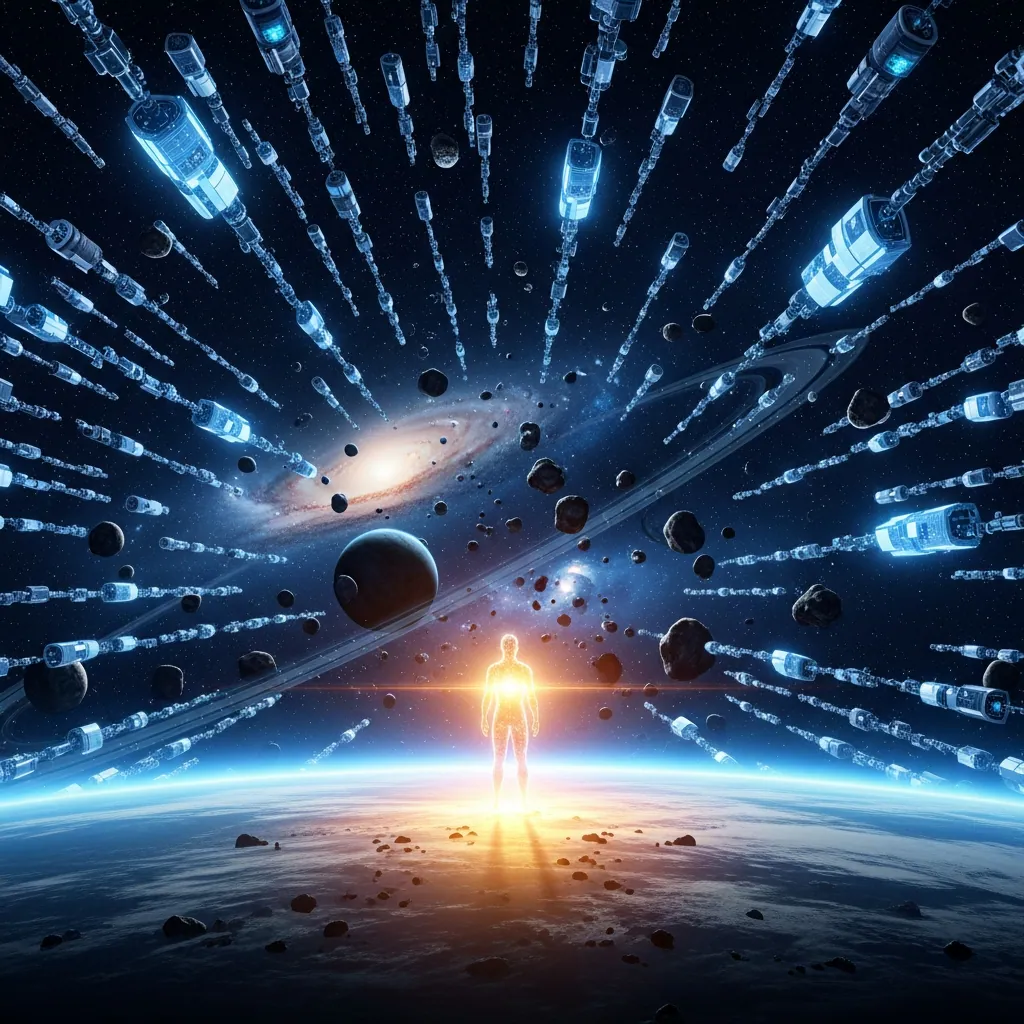
A Thought Experiment Worth Running
In 1800, there were roughly one billion human beings on Earth. It had taken our species approximately 200,000 years to reach that number. By 1927 we hit two billion. By 1974, four billion. By 2023, eight billion. The doubling time kept shrinking — and then, quietly, something shifted.
The United Nations now projects that global population will peak somewhere between 9.5 and 10.5 billion people around 2080, and then begin a long, slow decline. Fertility rates have fallen below replacement level in over 60 countries. In South Korea, the fertility rate hit 0.72 in 2023 — less than half the 2.1 needed to sustain population. Japan, Italy, Spain, Germany, China, Brazil — all declining or already past peak. The population explosion is over. What comes next is something we have no historical precedent for: a world of falling human numbers during a period of exponential technological growth.
Now run a second set of numbers alongside that demographic curve.
The Agent Explosion
In 2024, there were no commercially deployed autonomous AI agents of consequence. By 2025, tens of millions. By 2027, analysts estimate hundreds of millions of AI agent instances running continuously across enterprise infrastructure alone. By 2030, projections from leading AI researchers suggest the number of active AI agents — autonomous software systems executing tasks, managing workflows, running experiments, and interacting with the world — will exceed one trillion.
One trillion agents. Against roughly ten billion humans.
That is a ratio of 100 agents per human being, before accounting for the robotics layer.
The Robotics Layer
Humanoid and industrial robots are scaling on a curve that mirrors the early smartphone era. Boston Dynamics, Figure, 1X, Apptronik, Tesla Optimus, Unitree — the list of humanoid robot companies that have moved from research to production in the last three years is striking. Goldman Sachs projected in 2023 that the humanoid robot market could reach 6 million units by 2030. Revised estimates now run significantly higher, with Tesla alone targeting production of millions of Optimus units annually by the late 2020s.
By 2035, the combined population of deployed industrial robots (currently ~4 million globally, growing at 15% per year compounded) and humanoid robots could realistically reach 50–100 million units. By 2040, with continued exponential scaling, the number of physical robotic agents operating in the world could approach or exceed the number of human workers.
By 2050, in a scenario consistent with current trajectory, robots and AI agents outnumber humans in every economically meaningful ratio imaginable.
The Longevity Inflection
Now add a third variable: human lifespan.
In 1900, global average life expectancy was approximately 32 years. By 2023 it had reached 73 years — more than doubling in a century. The rate of improvement in lifespan extension has itself been accelerating in the last decade, driven by advances in senolytics, gene therapy, GLP-1 class drugs, AI-powered drug discovery, and our deepening understanding of the biology of aging.
Bryan Johnson, founder of the Blueprint longevity protocol, has demonstrated biological age reversal metrics that would have been considered impossible five years ago. Altos Labs, funded with over $3 billion, is pursuing cellular reprogramming to reverse aging at the molecular level. Unity Biotechnology, Calico (Google's longevity subsidiary), and dozens of biotech startups are all converging on similar targets.
Leading researchers including David Sinclair (Harvard) and Aubrey de Grey have argued that the first humans to live to 150 are already alive. More provocatively, some researchers believe we are approaching what de Grey calls "longevity escape velocity" — a point at which life extension technology advances faster than we age, effectively making biological death from aging optional rather than inevitable for those with access.
Conservative projections — not the most optimistic — suggest average life expectancy in developed nations could reach 100–120 years by 2075. Extended-life scenarios, considered increasingly plausible by mainstream gerontologists, suggest lifespans of 150–200 years for people alive today who access emerging longevity interventions.
The implication for population mathematics is profound. Longer-lived humans with lower birth rates means the human population decline from the 2080 peak will be slower than raw birth rate data suggests — people simply stay in the living column longer. But it also means the ratio of non-human intelligence to human beings keeps widening regardless.
The Multi-Planetary Variable
Elon Musk's stated goal is one million humans on Mars by 2050. SpaceX's Starship programme is the infrastructure layer for that ambition. Whether the number is one million or fifty thousand in that timeframe, the trajectory of human interplanetary expansion is now real rather than speculative — SpaceX has fundamentally changed the cost economics of getting mass to orbit and beyond.
By 2100, under plausible scenarios, there may be permanent human settlements on Mars, the Moon, select asteroid mining stations, and early-stage habitats in the outer solar system. The total number of humans living off-Earth in that timeframe: almost certainly under 10 million, possibly as few as one million.
Meanwhile, the AI agents and robotic systems that will be operating in space will number in the billions — autonomous mining systems, construction robots, scientific instruments, satellite networks, and infrastructure management agents.
In the entire accessible universe, across every planet, station, and habitat that humans occupy or build: human beings will be a vanishingly small presence relative to the machine intelligence operating alongside, around, and in service of them.
Running the Numbers: A Rough Forecast Table
| Year | Human Population | AI Agent Instances | Deployed Robots | Ratio (Non-human:Human) |
|---|---|---|---|---|
| 2025 | 8.2 billion | ~500 million | ~4 million | ~0.06:1 |
| 2030 | 8.6 billion | ~1 trillion | ~20 million | ~116:1 |
| 2040 | 9.2 billion | ~100 trillion | ~500 million | ~11,000:1 |
| 2060 | ~9.8 billion (peak) | ~1 quadrillion | ~5 billion | ~100,000:1 |
| 2080 | ~9.5 billion (declining) | Unknown | ~50 billion | >1,000,000:1 |
| 2100 | ~8 billion (declining) | Unknown | ~500 billion | >100,000,000:1 |
These are not science fiction estimates. They are extrapolations of current growth rates applied forward — the same kind of arithmetic that would have seemed absurd applied to smartphone penetration in 2005 but proved conservative by 2015.
By 2060, for every human being alive on Earth, there may be 100,000 non-human intelligence instances — agents, robots, automated systems — operating in the world.
What Rarity Means
Rarity is not merely a numerical concept. It is an economic and civilisational one.
Throughout human history, the scarcest things have commanded the highest value. Gold is precious because it is rare. Great art commands extraordinary prices because it cannot be replicated. The advice of a trusted mentor is worth more than a thousand AI-generated recommendations because the mentor is a singular human being with lived experience, emotional continuity, and genuine investment in your outcome.
As AI agents and robots take over every category of repeatable, rule-based, pattern-matching work — and eventually much of what we currently call "creative" and "cognitive" work — the singular, irreplaceable qualities of human consciousness become not less valuable, but orders of magnitude more valuable.
Human beings possess things that no current or foreseeable AI system can replicate:
Embodied experience. Consciousness that has navigated love, loss, physical sensation, hunger, longing, joy, and fear. These are not merely data points. They are the substrate of genuine understanding — the difference between knowing that grief is painful and having been broken by it.
Organic creativity. The capacity to make something that did not exist before, motivated by an inner compulsion that has no economic explanation. No AI system creates because it cannot help but create. Humans do.
Moral intuition. The ability to navigate genuine ethical dilemmas where no rule applies — where competing goods must be weighed against each other by a being with actual stakes in the outcome.
Relational authenticity. The irreplaceable experience of being truly known by another person. Of being loved not because an algorithm predicted you would respond positively to a particular interaction, but because another human being, in full knowledge of your flaws and failures, chose to stay.
Spiritual and existential depth. The capacity to confront the fact of our own mortality, the mystery of consciousness, the question of meaning — and to build cultures, religions, philosophies, and art that are responses to those questions.
None of this can be uploaded, replicated, or manufactured at scale. And in a universe increasingly filled with manufactured intelligence, these qualities become extraordinarily, perhaps cosmically, rare.
The Civilisational Conclusion
Here is the question that follows from this arithmetic:
If human beings are becoming the rarest intelligent entities in a universe increasingly populated by artificial minds — what does that mean for how we treat human beings?
Rare things are protected. Rare things are studied and cherished. Rare things are not discarded carelessly in the pursuit of short-term efficiency.
The companies, institutions, and civilisations that understand this early will build futures where human beings are at the centre — not as consumers to be extracted from, not as costs to be minimised, but as the irreplaceable organic intelligence at the heart of a universe that, for all its artificial brilliance, cannot produce another one.
The civilisations that do not understand this will optimise themselves toward a world of maximum machine efficiency and minimum human flourishing — and they will discover, perhaps too late, that they have optimised away the only thing that made any of it worth building.
This article is the first in a two-part series. The second explores the specific mistake that AI companies and corporations are making right now by treating human workers as costs to be cut rather than as the rare, irreplaceable resource they are becoming.
Explore AI resources shaping this future at artelogica.com.