Multimodal RAG: Chatting with Your Video and Audio Data
 Lorenzo Vallone
Introduction
"Retrieval-Augmented Generation" (RAG) was the buzzword of 2024. It solved the problem of AI hallucinations by forcing the model to "look up" facts in your company's documents before answering. But until recently, RAG had a massive blind spot: it could only read text.
If your company's knowledge was trapped in Zoom recordings, PDF charts, or technical diagrams, the AI was blind to it.
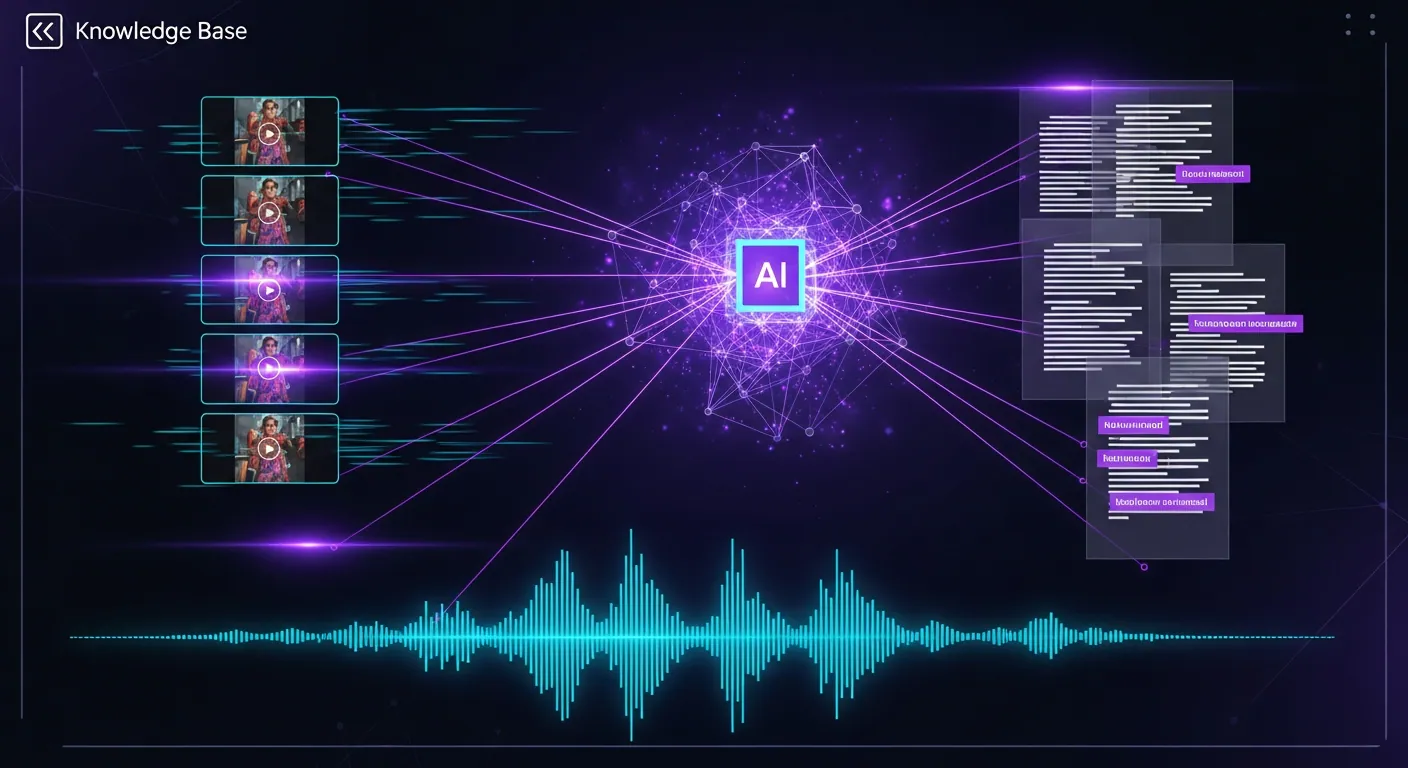
In 2026, Multimodal RAG has torn down these walls. We can now index and search pixels and soundwaves just as easily as text. The two technologies driving this are Vision-Language Indexing (ColPali) and Native Video Search (Twelve Labs).
The PDF Problem: Solved by ColPali
For years, "chatting with a PDF" was a lie. Under the hood, software would use OCR (Optical Character Recognition) to scrape the text, often turning a beautiful chart into a jumbled mess of numbers. The AI never actually saw the chart.
ColPali (ColBERT + PaliGemma) changed everything. Instead of scraping text, ColPali takes a screenshot of the document page. It treats the page as an image.
When you ask, "Which quarter had the highest revenue?", ColPali doesn't search the scraped text. It searches the image of the chart itself, matching your question to the visual location of the bars or lines. When it finds the answer (e.g., Q3), it returns the image of the page for the LLM to analyze. This has revolutionized fields like finance and engineering, where the data is often in the diagrams, not the text.
The Video Revolution: Twelve Labs
Searching video has historically been painful. You relied on filenames or manually typed tags. Twelve Labs introduced "Marengo" and "Pegasus," models designed to understand time and motion.
These models allow for Natural Language Video Search. You don't search for "file_final_v3.mp4." You search for:
"The moment where the CEO shakes hands with the partner in the blue suit."
The AI scans terabytes of video footage and returns a result like: Timestamp 04:23 to 04:28.
It understands actions (shaking hands), objects (blue suit), and context. This technology is currently being deployed by news agencies to archive footage and by security firms to scan surveillance video without human fatigue.
The Engine Room: Vector Databases
None of this works without a place to store these massive "multimodal embeddings." The traditional SQL database is useless here.
Vector Databases like Pinecone and Weaviate have evolved to handle this load. In 2026, they introduced "Hybrid Search" that combines keyword matching (for precise names) with vector matching (for concepts). They act as the long-term memory for these multimodal AI systems, allowing a user to query a database containing 1 million images and get a result in 200 milliseconds.
Conclusion
Multimodal RAG signifies the end of "unstructured data." In the past, video and audio were "dark data"—stored but unsearchable. Now, every frame of video and every pixel of a diagram is just as queryable as a row in an Excel spreadsheet.
Related Resources
Explore the tools mentioned in this article:
- Twelve Labs - Video understanding and search platform
- Pinecone - Managed vector database for AI applications
- Weaviate - Open-source vector database with ML models
- Hugging Face - AI community hosting ColPali and other models