Physical AI Goes Viral: The Table Tennis Champion and the Robot That Wouldn't Stop Dancing

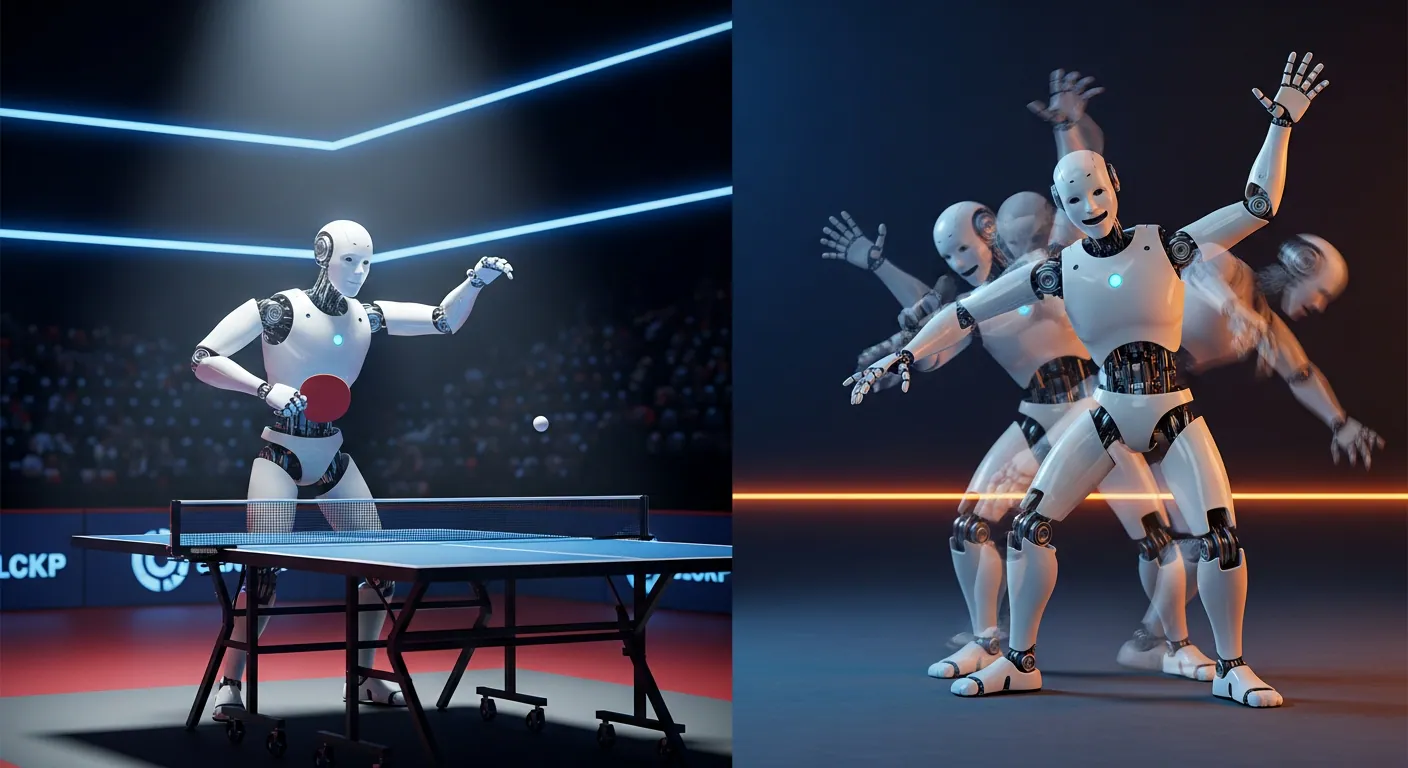
Two robot videos are making the rounds this week, and together they paint a surprisingly complete picture of where physical AI stands in 2025 — impressive, uneven, and occasionally in need of intervention.
<h2>The Table Tennis Milestone</h2> <p>The first video, from AP News, shows a robot defeating professional human players at table tennis. Not recreational players. Pros. The robot's maker calls it a milestone for machines — and they're not wrong.</p> <p><a href="https://apnews.com/video/a-robot-is-beating-human-pros-at-table-tennis-its-maker-calls-it-a-milestone-for-machines-968b5ebac8cc44fd9e47159b80722aba" target="_blank" rel="noopener noreferrer">Watch: A robot beats human pros at table tennis (AP News)</a></p> <p>What makes this significant isn't just the score. Table tennis is one of the most physically demanding cognitive challenges you can throw at a machine. The ball moves at extraordinary speed — sometimes exceeding 100 km/h — and the physics of spin, bounce angle, and opponent positioning shift on millisecond timescales. A robot must perceive the ball's trajectory in flight, compute the optimal return, physically position itself, and execute a precise swing, all before the ball arrives. Repeatedly.</p> <p>The fact that a machine can now do this well enough to beat human professionals represents a genuine convergence: computer vision, real-time inference, motion planning, and actuator control are now fast and accurate enough to compete at the highest level of a reflex-based human sport. That convergence is the milestone. Table tennis just happened to be the test.</p> <p>For the broader field of physical AI — robots that must act in real-world, dynamic environments rather than controlled factory settings — this is meaningful signal. The same capabilities that return a topspin forehand at match pace are the capabilities you need for warehouse logistics, surgical assistance, and disaster response robotics.</p> <h2>The Dance Floor Menace</h2> <p>Then there is the second video.</p> <p><a href="https://apnews.com/video/staff-struggle-to-restrain-dancing-robot-6d957cf7d51442f1bea51eef63c44e67" target="_blank" rel="noopener noreferrer">Watch: Staff struggle to restrain a dancing robot (AP News)</a></p> <p>Where the table tennis robot is all precision and restraint, this one is neither. A humanoid robot — clearly programmed to dance for an audience — gets into it a little too enthusiastically. Staff move in to calm things down. The robot does not calm down. The resulting footage is a perfect comedic counterpoint to every breathless announcement about the coming age of robot autonomy.</p> <p>The clip is funny because it captures something true: giving a machine physical agency in an open environment, around people, is still genuinely hard. The gap between "this robot can dance" and "this robot can dance appropriately for this context and stop when asked" is not a small gap. It is, arguably, the gap where most of the remaining hard problems in robotics live.</p> <h2>What Both Videos Are Actually Saying</h2> <p>Taken together, these two clips illustrate the central tension in physical AI right now. Machines are becoming extraordinarily capable at specific, well-defined physical tasks — table tennis, welding, package sorting, walking across terrain. But contextual judgment, social awareness, and knowing when to stop are still deeply difficult.</p> <p>The table tennis robot wins because the rules are clear, the environment is controlled, and success is measurable. The dancing robot struggles because the real world has none of those properties. The audience shifts. The appropriate response changes. And nobody has yet handed the robot a good model of "this is getting to be too much."</p> <p>That gap — between task performance and situational judgment — is where the next decade of physical AI research will be spent. The hardware is increasingly capable. The question is whether the intelligence running it can match the complexity of the environments it operates in.</p> <p>For now: the table tennis robot is a milestone. The dancing robot is a reminder. Both are worth watching.</p> <hr/> <p><em>Interested in tracking the state of physical AI and robotics? Browse the <a href="/browse?category=ROBOTICS" target="_blank">Robotics category</a> in the ARTE LOGICA directory.</em></p>