The Physics of Intelligence: Rob Ferguson on the Real Future of AI
 Lorenzo Vallone
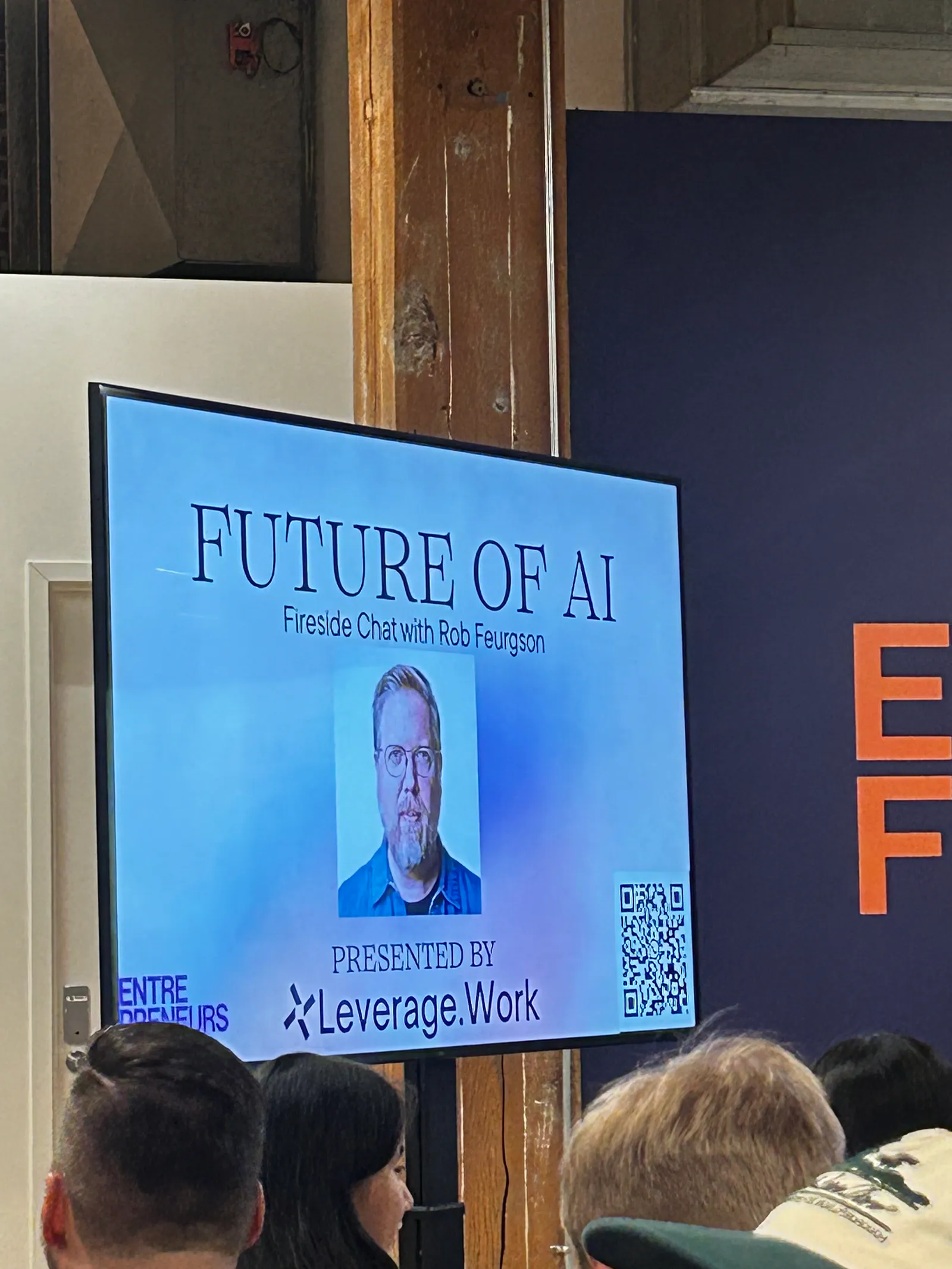
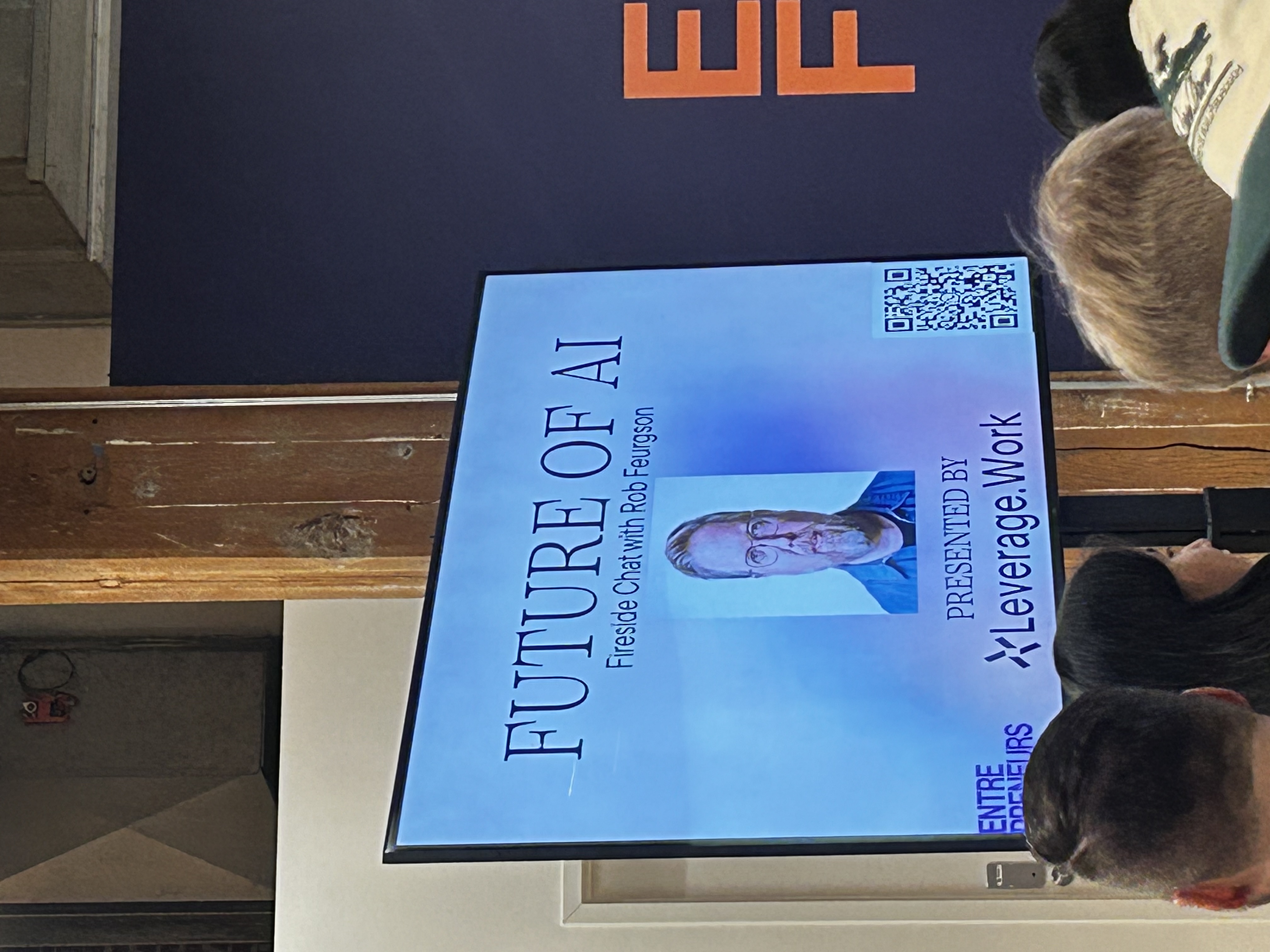
At a packed industrial loft in San Francisco, the energy was unmistakable. The event, "The Future of AI," presented by Leverage.Work, featured a fireside chat with Rob Ferguson — formerly the Head of AI for Microsoft for Startups and now a key figure at Fireworks AI. Ferguson offered a masterclass not on the hype of artificial intelligence, but on its "physics" — the economic, infrastructural, and operational realities that will determine who survives and who doesn't.
Addressing a standing-room-only crowd, Ferguson moved past the standard talking points of generative AI to discuss the gritty reality of building in the current ecosystem. His message was clear: we are moving from a phase of unchecked experimentation into an era defined by unit economics, GPU scarcity, and the complex "trust loops" of agentic workflows.
The Economics of Experimentation
Ferguson began by addressing the mindset required for founders in the early stages of AI adoption. Having overseen the distribution of massive resources at Microsoft, his advice on cloud credits was counter-intuitive to the "scarcity mindset" many founders hold.
"Go get yourselves as many credits as you possibly can," Ferguson urged. He observed that too many founders hoard their compute credits, treating them like a savings account rather than fuel. His philosophy is that these resources exist to be burned in pursuit of the best possible model. "Run against it as best as you can... Too many of the founders that I coach end up leaving with 80,000 credits," he noted, lamenting that they spent their time optimizing software architecture rather than iterating on the AI itself.
However, this profligacy comes with a warning. Once traction is achieved, the "physics" of the business takes over. Ferguson pointed out that the transition from a prototype to a scaled product often reveals brutal economic truths. "You create something really cool... and then you start adding features... and now you're at $50,000 a month," he explained. This is where the "physics" analogy becomes literal. He highlighted the pitfalls of heavy data modalities, such as video and audio processing, which can rapidly consume budgets that looked comfortable during the prototype phase.
The "Amazon Basics" Problem and Competitive Strategy
A recurring anxiety in the room was the threat of major incumbents — specifically Microsoft, AWS, and OpenAI — swallowing up startup use cases. Ferguson drew on his own history to offer a sobering but pragmatic perspective. He recounted his time at a music startup that was technically superior but was eventually crushed when Spotify offered a similar product for free, backed by "infinite money."
He also touched on the "Sherlock" phenomenon — referencing when Apple integrates a developer's feature into the OS. He described the frustration of watching AWS launch a feature that effectively wiped out a partner's core business model a week after they launched. "It sucks," Ferguson admitted. "But... the competition helped them be able to go through and be a little bit more differentiated."
His advice to the room was to assume that commoditization is inevitable. If a startup is building something that a platform can easily replicate (the "Amazon Basics" version), they are in the kill zone. The solution is to find "whole businesses that they would never go after." He cited a mentee who pivoted from a general idea to specifically handling compliance for Airbnb hosts — a messy, unsexy, medium-sized business that giants would ignore, but which proved highly lucrative.
Defining Agents: The Trust Loop
The conversation inevitably turned to "Agents," the buzzword of the moment. Ferguson was quick to dismantle the hype, noting that if you ask 50 people to define an agent, you get 50 different answers.
For Ferguson, the definition of an agent isn't about complex routing or orchestration frameworks; it is about the Trust Loop. "The fundamental metric... is how long is it before your user can trust the output?" he posited.
He argued that the industry is currently obsessed with the wrong metrics. Founders are building complex multi-agent systems without measuring the basic "time-to-trust." He used the example of "Deep Research" as the world's current "best agent" — a system that gathers data, synthesizes it, and presents it in a way that allows the human to verify and trust the result.
He also warned against the "chat box" fallacy. While ChatGPT popularized the chat interface, Ferguson argued that true agentic workflows happen in the background. "It's not just a chat box... it's actually noticing if you copy the output... it uses that information," he explained. The future of agents lies not in conversational partners, but in systems that can asynchronously process work — like his own workflow of dictating thoughts during his commute and having an agent organize them into structured notes by the time he arrives at the office.
The Infrastructure Wars: GPU Scarcity and the Moat
Perhaps the most technical and forward-looking portion of the chat focused on the hardware underlying the AI revolution. Ferguson painted a picture of a world defined by "GPU scarcity."
"Right now, there's this huge competition of which people have access to intelligence," he noted, describing the current environment as "anti-egalitarian." The largest players — governments and hyperscalers — are hoarding compute, buying up billions of dollars in infrastructure that isn't even attached to current revenue streams yet.
While new entrants like Groq and Cerebras (whom he praised for their recent releases) are entering the hardware market, Ferguson remains skeptical of a quick shift away from Nvidia. The reason isn't hardware performance, but "developer ergonomics." Nvidia has a decades-long head start on the software stack (CUDA). "There's a big difference between models and intelligence... and intelligence delivery," he said. A new chip might be faster, but if it lacks the libraries and the ease of use that developers depend on, adoption will be slow.
The Shift to Fireworks AI and the "Engineer Era"
Ferguson's move to Fireworks AI represents his bet on the next phase of this cycle. He described the frustration of seeing startups "run themselves out of runway" because they were renting generic, massive models for specific, narrow tasks.
The future, according to Ferguson, is not one giant model that does everything (AGI), but "many, many models." He sees a shift toward smaller, purpose-built models that companies can actually own and fine-tune. This is where the economics make sense. "I can actually find a model that is really purpose-built for what I'm doing at an 11x lower cost," he explained. This ability to own the model and control the economics is the only way to survive the "physics" of scaling a business.
This is the core thesis behind Fireworks AI — providing the infrastructure for companies to deploy and fine-tune purpose-built models rather than paying premium rates for one-size-fits-all solutions.
The SaaS Mirage and the Security Horizon
A question from the audience probed the "SaaS Apocalypse" — the idea that AI will replace traditional software-as-a-service models. Ferguson's take was nuanced. He called the idea that SaaS is dying a "mirage."
While AI agents can theoretically do the work of software, the friction lies in identity and data. "Identity is really, really hard," he said. "Figuring out who should have access to what... is still quite difficult." Until agents can securely navigate the complex permissions and data silos of the enterprise, traditional SaaS applications — which serve as trusted containers for this data — will remain. He noted that only about 5% of data is public; the rest is locked in organizational silos that agents can't yet reliably access.
This led to a final, darker note on security. Ferguson admitted that security is currently a "mess." The attack surface is expanding exponentially as AI agents are given more autonomy. "We don't know where we are going," he admitted regarding the security landscape, noting that even basic systems are vulnerable and that AI is being used by bad actors just as effectively as by defenders.
The Bottom Line
Despite the talk of GPU scarcity, automated agents, and infrastructure costs, Ferguson closed on a human note. He reflected on the changing nature of work, noting that his ability to manage tasks has increased because he can now deploy "ten agents" to handle parallel processing.
The future he described isn't one where humans are obsolete, but one where they are conductors of a digital orchestra. Just as he likened a growing startup to a band that eventually becomes an orchestra requiring different management styles, the "Future of AI" is about learning to orchestrate these new, powerful instruments.
The takeaway was clear: the magic of the "demo phase" is over. We are now in the engineering phase, where the winners will be decided not by who has the flashiest demo, but by who understands the physics, the economics, and the infrastructure of intelligence.
Rob Ferguson spoke at the "Future of AI" event presented by Leverage.Work in San Francisco. He is formerly the Head of AI for Microsoft for Startups and currently leads initiatives at Fireworks AI.