The Sky Over San Francisco: Why the Bay Area Is the Perfect Launchpad for Urban Air Mobility
 Lorenzo Vallone
Every weekday morning, tens of thousands of people make a journey that perfectly captures both the promise and the paradox of the Bay Area. It starts in Mountain View — home to some of the most advanced technology companies on Earth — and ends roughly 38 miles north in San Francisco. By car, in rush hour, that trip routinely takes an hour and forty minutes. By Caltrain, door to door, about an hour and a half. Thirty-eight miles. Ninety to one hundred minutes. In the region that invented the future, we move at the speed of 1955.
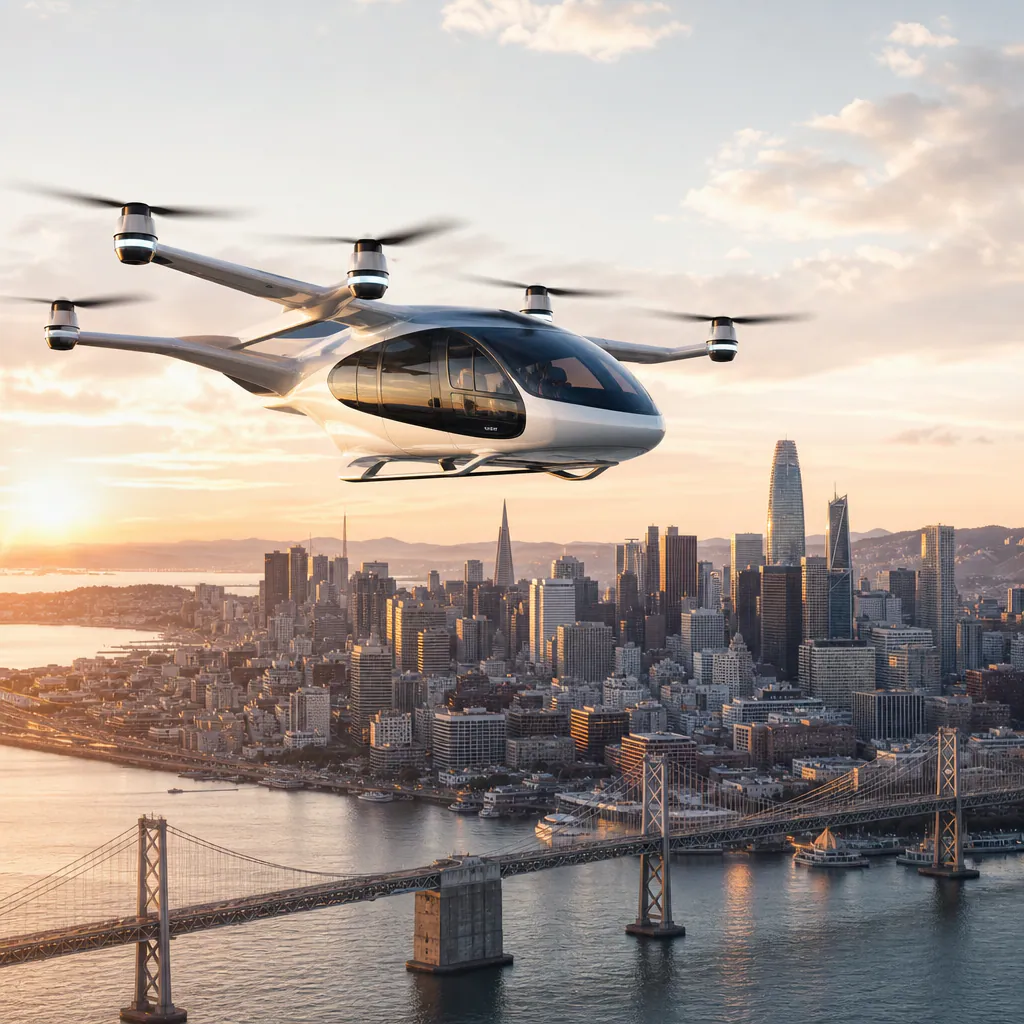
Here is the twist: that absurdity is not San Francisco's weakness. It is San Francisco's opportunity. The same density, geography, wealth, and talent that make Bay Area congestion so painful also make it the single best place on the planet to launch the next era of urban transportation — electric vertical takeoff and landing aircraft, better known as eVTOLs. Flying vehicles are no longer science fiction. They are flying today, in test programs, over California. And the city they should transform first is the one staring at them from across the runway.
The Numbers: What Congestion Actually Costs
Let's put real figures on the pain, because the pain is the size of the market.
According to INRIX's Global Traffic Scorecard, the typical San Francisco-area driver loses on the order of 90+ hours per year to congestion — among the worst in the United States, in the same league as New York and Chicago. The Texas A&M Transportation Institute's Urban Mobility Report has estimated the annual cost of congestion in the San Francisco–Oakland area in the billions of dollars, driven by wasted fuel and, far more importantly, wasted time.
Now translate hours into dollars. The Bay Area has one of the highest concentrations of high-wage knowledge workers in the world. Take a conservative fully-loaded value of $100 per hour for a senior engineer, designer, or founder — many are worth several multiples of that — and multiply by 90 lost hours a year. That is $9,000 per worker, per year, evaporating in brake lights on the 101. Scale that across a workforce of roughly four million people in the nine-county Bay Area, even discounting heavily for remote work and off-peak commuters, and you land comfortably in the tens of billions of dollars of annual productivity loss for a single metropolitan region.
And that's just the measurable part. It ignores the meetings that never happen, the hires who decline offers because of the commute, the founders who move to Austin, and the sheer cognitive drag of spending 400 minutes a week watching someone else's bumper.
The Mountain View → SF corridor is the perfect anchor example. In a straight line, it's about 35 miles. An eVTOL cruising at 150–200 mph covers that in roughly 15 minutes. Not an incremental improvement — a 6x reduction. That is the kind of step change that reorganizes where people live, work, and build.
Why Roads Can't Fix This
The instinctive answer to congestion is "build more roads." In the Bay Area, that answer fails on three independent grounds.
Geometry. San Francisco is a 49-square-mile peninsula surrounded by water on three sides. The corridors that feed it — the 101, 280, the Bay Bridge, the Golden Gate — are hemmed in by bay, ocean, and mountains. There is physically nowhere to put meaningful new capacity. Widening the 101 through the Peninsula would require demolishing some of the most expensive real estate in human history.
Economics. Where expansion is theoretically possible, the costs are staggering. Bay Area infrastructure projects routinely run into billions of dollars per mile and decades of planning, review, and litigation. The Bay Bridge eastern span replacement — a single bridge segment — took over a decade and cost more than $6 billion.
Induced demand. Even when lanes do get built, the traffic comes back. Decades of transportation research show that added road capacity fills up within a few years as latent demand surfaces. More lanes generate more driving. It is one of the most consistently replicated findings in urban planning.
The ground layer is saturated, and it cannot be meaningfully expanded. But look up. Above every congested freeway in the Bay Area sits an effectively empty, three-dimensional transportation corridor. The sky doesn't need eminent domain.
The Human Variable
There is a second, subtler problem with roads: us.
Traffic jams are not primarily caused by too many cars — they are caused by how inconsistently humans drive. Phantom traffic jams, the ones that materialize with no accident or obstruction in sight, are a well-studied phenomenon: one driver brakes slightly too hard, the following driver overcorrects, and a compression wave ripples backward for miles. Add rubbernecking, lane-weaving, distracted merging, and delayed reactions, and you get the wild variability that makes a 38-mile trip take 45 minutes one day and 100 the next.
This is why autonomy matters so much — and why the Bay Area's proof point is already driving around San Francisco. Waymo now operates fully driverless robotaxis across San Francisco and the Peninsula, completing hundreds of thousands of paid rides per week across its cities with a safety record that, per its published data, significantly outperforms human drivers on injury-causing collisions. Tesla FSD is attacking the same problem from the consumer side, shipping camera-based autonomy to hundreds of thousands of ordinary vehicles. Whatever your view on timelines, the direction is unambiguous: machine drivers are smoother, more predictable, and more cooperative than human ones.
Now move that logic into the air. Aviation is actually an easier environment for autonomy than a city street — no pedestrians, no double-parked delivery vans, no left turns across traffic. Air traffic is already the most procedurally controlled transportation domain on Earth. Autonomous or highly automated eVTOL corridors, managed by software, can achieve a throughput and consistency that no freeway ever will.
The Companies Are Already Here — and Already Flying
Here is the part that surprises people who haven't been paying attention: the aircraft exist. They fly. And the companies building them are overwhelmingly Californian.
Joby Aviation, headquartered in Santa Cruz, has been flying full-scale prototypes for years. Its five-seat aircraft cruises around 200 mph with a range of roughly 100 miles — Mountain View to SF is a rounding error. Joby is deep into FAA type certification, holds a Part 135 air carrier certificate, is backed by Toyota and Delta, and has already begun delivering aircraft for early operations in Dubai ahead of U.S. launch.
Archer Aviation, based in San Jose, is on a parallel path with its Midnight aircraft — a four-passenger eVTOL designed for rapid back-to-back short hops, backed by Stellantis and United Airlines, with a planned air taxi network for the 2028 LA Olympics.
Wisk Aero, the Mountain View company fully owned by Boeing, is taking the boldest swing of all: skipping the pilot entirely. Its Generation 6 aircraft is designed to be autonomous from day one — self-flying, with human oversight from the ground. Wisk is essentially building the Waymo of the sky, a few miles from where Waymo built the Waymo of the ground.
Supernal, Hyundai's air mobility company, brings something the startups can't: the manufacturing muscle of a global automaker, aimed squarely at producing eVTOLs at automotive scale and cost.
Even the cautionary tales reinforce the thesis. Germany's Lilium — one of the most ambitious eVTOL programs in Europe — collapsed into insolvency in 2024, and its technology and assets were picked over by better-capitalized players. The lesson wasn't that eVTOLs don't work. The lesson was that this industry consolidates toward deep capital, regulatory proximity, and dense early markets. In other words: toward California.
What the Bay Area Already Has
Stack up what a launch market for urban air mobility actually needs, and San Francisco reads like the spec sheet was written for it.
- Painful, high-value routes. Mountain View–SF, Oakland–Palo Alto, Marin–SoMa: short straight-line distances, brutal surface travel times, and passengers whose time is extraordinarily valuable. This is exactly the demand profile where a premium airborne service works on day one and gets cheaper from there.
- Aviation infrastructure. The Bay Area is ringed with underused general aviation airports — Palo Alto, San Carlos, Hayward, Oakland, Half Moon Bay — plus dozens of rooftop helipads downtown. The skeleton of a vertiport network already exists.
- The talent. Battery engineers, autonomy researchers, aerospace veterans, and software talent, all within a 40-mile radius. The people who will certify, operate, and improve these aircraft already live here — and currently spend 90 hours a year stuck on the 101 thinking about it.
- The capital. The venture and industrial capital funding this entire industry is concentrated on Sand Hill Road and in South Bay corporate development offices. Joby, Archer, and Wisk are all local companies. Their first commercial market should be their home one.
- The proof of autonomy. No other city on Earth has normalized driverless vehicles the way San Francisco has. A population that shrugs at empty Jaguars navigating Nob Hill is a population ready to board a quiet electric aircraft at a vertiport.
And quiet is the right word. These are not helicopters. Distributed electric propulsion makes eVTOLs dramatically quieter — Joby's aircraft is barely perceptible above urban background noise at cruise altitude. Zero operational emissions, no fuel logistics, and maintenance profiles closer to electric cars than turbine helicopters.
The Question Is No Longer "If"
Be clear-eyed about what remains: FAA type certification is a rigorous, multi-year process, and it should be — that rigor is why commercial aviation is the safest transportation mode humans have ever built. Vertiport networks need siting, charging infrastructure, and air traffic integration. Early flights will be premium-priced before scale brings costs down toward ground transportation, the same curve every transportation technology has followed, from railroads to airlines to robotaxis.
But notice what is not on that list anymore: the technology. The aircraft fly. The batteries hold. The autonomy stack works — it's driving passengers around San Francisco right now, every day, at scale. The remaining work is infrastructure and regulation, and those are exactly the kinds of problems that determined regions solve when the payoff is measured in tens of billions of dollars a year.
Somewhere in Mountain View this morning, an engineer got into a car for a 100-minute crawl to a San Francisco meeting — possibly to work on the very aircraft that will make that crawl obsolete. Within a decade, that same trip should be a 15-minute flight over the Bay, in a quiet electric aircraft, quite possibly with no pilot on board and nobody finding that remarkable.
The Bay Area has spent seventy years compressing the distance between an idea and the world. Compressing the distance between Mountain View and San Francisco is the most Bay Area problem imaginable — and for the first time, everything needed to solve it exists, flies, and is headquartered within 40 miles of the Golden Gate. The sky over San Francisco isn't empty. It's the region's largest piece of unused infrastructure, and it's about to open for business.