The Solo Unicorn, Part 3 — Growing: Marketing, Sales, and Support on Autopilot
 Lorenzo Vallone
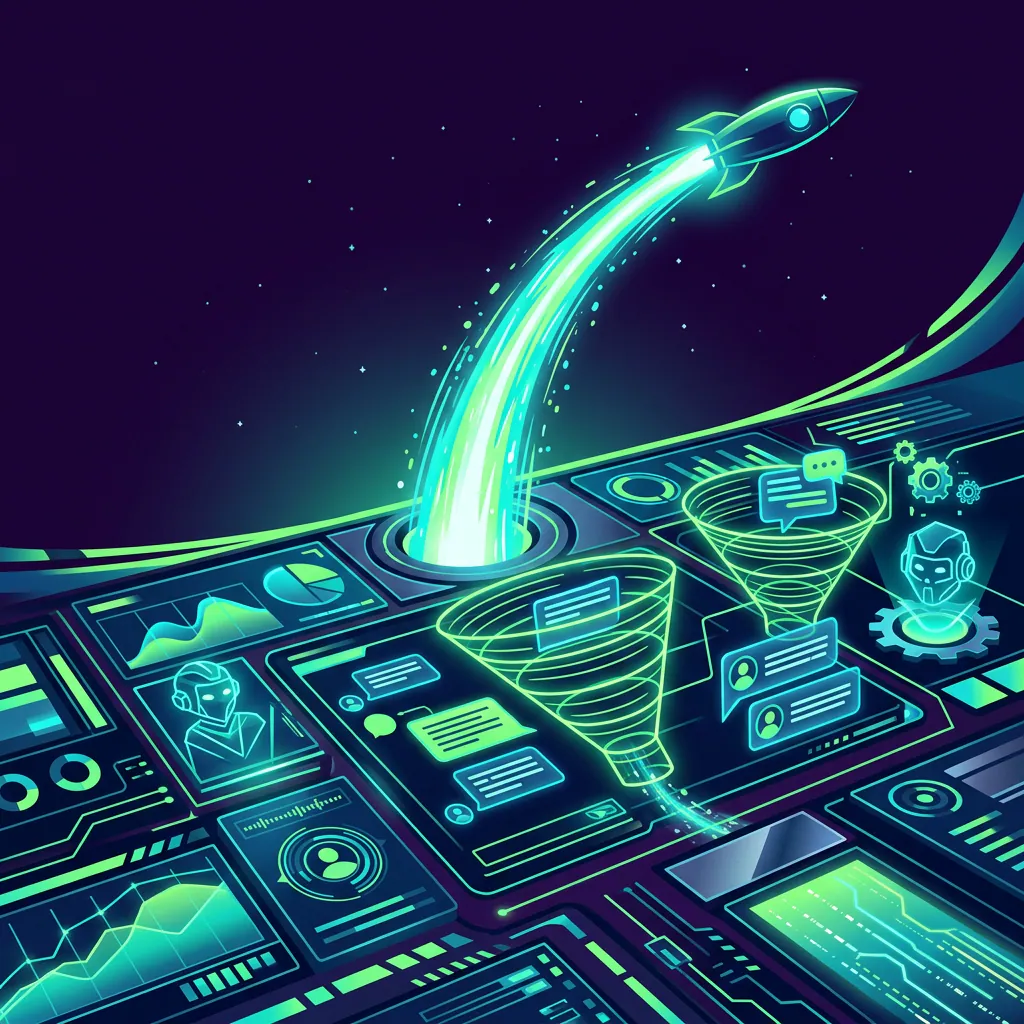
We've covered how a solo founder builds a product without a team and runs a back office of one. Now the hard part: growth. Building and bookkeeping scale with the founder's discipline. Marketing, sales, and support scale with the customer count — which means they are the first functions where a company of one either automates or suffocates.
Marketing: the content machine
Marketing rewards volume and consistency — historically the two things a solo founder can least afford. AI inverts that.
- One insight, many artifacts. The working pattern is a content engine: the founder produces the scarce ingredient — a genuine insight, a customer story, a strong opinion — and AI transforms it into the long-form post, the social threads, the newsletter section, the video script. One hour of founder thinking becomes a week of channel presence.
- SEO as a system, not a hobby. Keyword research, content briefs, internal linking, technical audits — the mechanical majority of search marketing is now automatable. The founder sets the strategy: which topics, for which buyer, with what point of view.
- Advertising with tight feedback loops. AI generates creative variants and ad platforms optimize delivery — but a solo founder's real advantage is speed of iteration: kill losing angles in days, feed winning language back into every other channel.
- The authenticity constraint. Audiences are increasingly fluent at detecting AI sludge. The engine only works when a real human's taste and stakes are visibly in the loop. Automate the production, never the perspective.
Sales: qualification at scale, closing with a human face
For a product-led business, AI can now run the whole top of the funnel: enriching leads, personalizing outreach, answering product questions, booking demos. The founder appears exactly where a human matters — the demo, the negotiation, the relationship with the flagship account.
The discipline is segmentation honesty: self-serve customers should never need to talk to you; enterprise buyers should always be able to. AI's job is making sure you spend your irreplaceable founder-hours only on conversations that genuinely require them.
Customer support: the first fully-agentic function
Support is arguably the function furthest along the automation curve. Modern AI support agents — grounded in your docs, your product data, and your past tickets — resolve the majority of routine inquiries end-to-end, around the clock, in any language.
The solo founder's playbook:
- Ground the agent in truth. The support AI is only as good as the documentation and product data behind it. Writing great docs is now a growth activity, not a chore — every improvement compounds through every future conversation.
- Design the escalation path first. Decide before launch what the AI must never handle alone: refunds above a threshold, security reports, angry customers, anything legal. The failure mode isn't AI answering badly — it's AI answering confidently where it shouldn't answer at all.
- Mine the tickets. Support conversations are the cheapest product research that exists. AI summarization across every ticket, every week, tells a solo founder what a VP of Product used to synthesize from a team of PMs.
Why manual mode breaks here
Now step back and look at the whole growth machine: ad copy, long-form SEO content, outreach emails, demo answers, support resolutions, ticket analysis. These are wildly different cognitive tasks. The model that writes emotionally resonant ad copy is not the model that should answer a billing dispute with precision, and neither is the one that should crunch a thousand tickets into a product insight.
Run all of that through one general-purpose model on default settings — manual mode — and everything comes out mediocre: support that's almost right, copy that's almost compelling, analysis that's almost trustworthy. At small scale, mediocre is survivable. At unicorn scale, those "almosts" multiply across every customer interaction, every day.
This is the thesis of The Master Architect, and growth is where it stops being abstract: the difference between a lifestyle business and a scaled one is whether each task runs on machinery tuned for that task — selected, benchmarked, and improved automatically. Today's routers already prove the principle inside single products, beating frontier models on satisfaction at a fraction of the cost. The solo founders who reach escape velocity will be the ones who apply that principle across the entire business.
The series in one paragraph
One person can now build a real product, run a compliant back office, and operate a growth machine — because AI has absorbed most of the specialized labor that used to force hiring. What AI has not absorbed is judgment: what to build, which risks to take, when to escalate to humans, and what the company stands for. The founders who win won't be the ones doing ten jobs badly. They'll be the ones directing orchestrated, task-tuned AI to do ten jobs well — while they do the one job that was always theirs: deciding what matters.
ARTE LOGICA helps founders and organizations design exactly these AI systems — from strategy to working software. Explore our services or browse our curated AI directory to see the tools shaping this shift.