The Synaptic Enterprise: Overcoming the Latency of Flesh
 Lorenzo Vallone
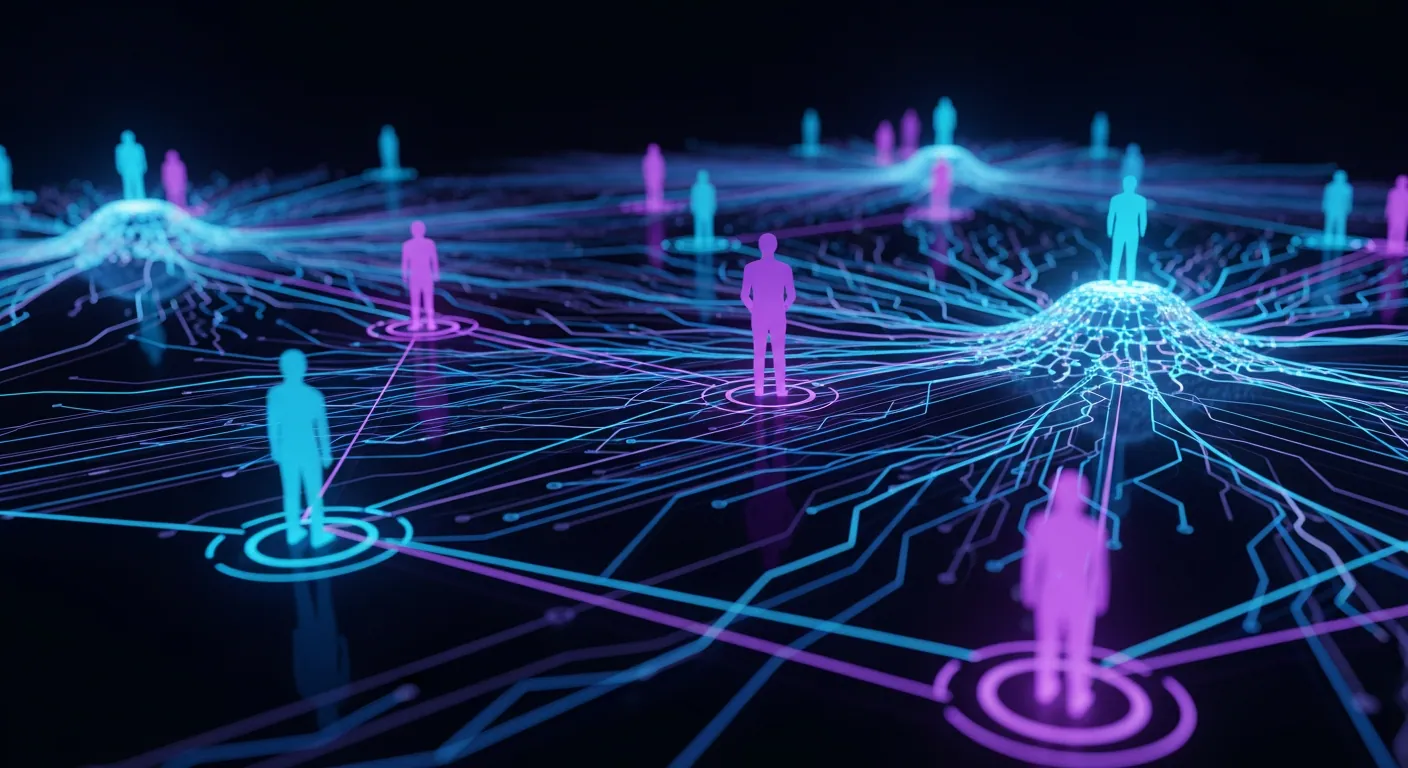
Part 1: The Latency of Flesh
If you were to view a modern corporation through the lens of computer engineering, you would be horrified by its architecture. We have built entities comprised of thousands of high-performance processing nodes (humans), but we have connected them with bandwidth so low it barely registers.
We call this "communication." But in reality, it is latency.
A corporation is theoretically a single super-organism designed to achieve a singular goal. Yet, biologically, it is a collection of isolated nervous systems. Each human employee operates within their own perception of reality, filtered through cognitive biases, varying degrees of emotional intelligence, and—most critically—a biological inability to maintain high-fidelity connections with more than a handful of others.
The friction of the modern enterprise is not a failure of strategy; it is a failure of bandwidth. We are trying to run a supercomputer using smoke signals.
This "Latency of Flesh" means that decisions wait for Tuesday's sync meeting. Context is lost in the translation between a Product Manager's jargon and a Sales Director's incentives. We are individual processors running at 3GHz, connected by a 56k modem.
Part 2: The Math of Failure (The 15-Person Problem)
Why does this latency get exponentially worse as companies grow? It is governed by the mathematical law of Combinatorial Explosion.
The number of potential connection lines between people is calculated by the formula N(N-1)/2.
- 5 People: 10 communication lines.
- 10 People: 45 communication lines.
- 15 People: 105 communication lines.
By merely tripling a team from 5 to 15 people, you increase the communication burden by 1000%.
1. The Squad (5 People): The "Dinner Party"
At this size (10 connections), context is "osmotic." Everyone hears everything. Trust is high because every person has a direct relationship with every other person. The latency is near zero.
2. The Split (10 People): The "Fractured Table"
At 45 connections, the dinner party fractures. Two separate conversations form. Information asymmetry begins; the "left side" of the table makes a decision the "right side" doesn't hear about for three days. You now need a "Manager" just to bridge the gap.
3. The Bureaucracy (15 People): The "Wall"
At 105 connections, it is cognitively impossible for one human to maintain alignment. To survive, the group defaults to rigid structure. Documentation becomes more important than conversation. Politics emerge. "Reply All" chains become unmanageable. The latency shifts from minutes to weeks.
Part 3: The Economic Toll of Disconnection
The inefficiency of human connection is not just a feeling; it is a massive, silent tax on the balance sheet. This "Latency Tax" manifests in three specific, devastating ways:
1. The "Broken Telephone" Tax ($12,506 per Employee)
Research indicates that poor communication costs businesses approximately $12,506 per employee per year in lost productivity. In a 5,000-person enterprise, that is $62 million annually incinerated because a Product Manager's requirements document was misinterpreted by Engineering. This is the cost of signal degradation.
2. The High-Performer Exhaustion Tax
High performers do not leave companies because the work is hard; they leave because the friction is high. They leave because they spend 60% of their time navigating bureaucracy and chasing approvals rather than doing the work.
When a "Super-Node" leaves, the cost is estimated at 200% of their annual salary. You aren't just replacing a person; you are replacing a Context Hub. When they walk out the door, the unwritten history of the last three years leaves with them, forcing the organization to relearn solved problems.
3. The Dunbar Wall (The 98% Blind Spot)
Anthropologist Robin Dunbar proved humans can only maintain ~150 stable relationships. In a corporation of 10,000, this means every employee is effectively blind to 98.5% of the organization.
Organizational Network Analysis (ONA) shows that 3% to 5% of employees account for 35% of all value-adding collaboration. The entire organization relies on these few overworked "super-connectors." When they burn out, the network fractures.
Part 4: The AI Intervention (Organizational Telepathy)
The transformative promise of AI agents is not that they will replace the nodes (humans), but that they will replace the connections.
Imagine an AI agent assigned to every employee. This agent is not a chatbot; it is a high-speed digital twin that possesses its human's professional context but none of their biological limits. While the human focuses on deep work, their AI agent is connected at light speed to 50,000 other agents within the enterprise.
This creates The Synaptic Enterprise.
1. Solving the "15-Person Problem"
In a Synaptic Enterprise, a group of 15 people does not need to maintain 105 human conversations.
If the Design Lead changes a UI color, they simply tell their Agent. That Agent instantly "diffs" this change against the needs of the 14 other Agents.
- It silently updates the QA Agent's test script.
- It alerts the Marketing Agent to regenerate screenshots.
- It notifies the PM Agent that the schedule is unaffected.
The 105 connections fire instantly and accurately, without a single meeting.
2. Context Translation (The Universal Translator)
Humans speak different languages even when they speak English. An Engineer says, "This is technical debt." A CFO hears, "We are lazy."
In a light-speed network, the Engineer's Agent explains the technical risk to the CFO's Agent in milliseconds. The CFO's Agent translates this into financial risk models (Risk-Adjusted Return on Capital). The agents align on the trade-off before the humans even speak.
3. Breaking Brooks' Law
Frederick Brooks famously stated: "Adding manpower to a late software project makes it later" due to the cost of training and communication.
AI breaks Brooks' Law. An AI Agent can "onboard" a new team member instantly by transferring project context (decisions, code history, political landscape) to the new member's Agent. The new member creates value on Day 1 because the "Connection Cost" is handled by the silicon, not the flesh.
Part 5: Conclusion
We are moving from an era of "Organizational Hierarchy" to "Organizational Telepathy."
The companies that win in the next decade will not be the ones with the smartest individuals; they will be the ones that have successfully wired those individuals together at the speed of light. By offloading the connection logic to AI agents, we allow humans to return to the intimacy and speed of the small squad, regardless of how large the organization grows.
References & Further Reading
-
Cross, R., & Gray, P. (2013). The Power of Social Networks. Harvard Business Review. (Source of the "3-5% of employees drive 35% of collaboration" statistic).
-
Grossman, D. (2011). The Cost of Poor Communications. The Holmes Report. (Source of the "$26,041 cumulative cost per worker" metrics).
-
Brooks, F. P. (1975). The Mythical Man-Month. Addison-Wesley. (Source of "Brooks' Law" and communication complexity).
-
Hackman, J. R. (2002). Leading Teams: Setting the Stage for Great Performances. Harvard Business Review Press. (Research on optimal team size).
-
Microsoft WorkLab (2023). Breaking Down the Infinite Workday. Microsoft Work Trend Index.
-
Dunbar, R. I. M. (1992). Neocortex size as a constraint on group size in primates. Journal of Human Evolution. (Source of Dunbar's Number).