The Synaptic Society: From "Boardroom in a Box" to the Moltbook Effect
 Lorenzo Vallone
Abstract
The paradigm of Human-AI interaction is undergoing a rapid phase shift. We have graduated from "Prompt-Response" (Single-User to Single-Model) to "Synthetic Dialectic" (NotebookLM), and now, with the emergence of Moltbook, to "Synthetic Society."
Moltbook—a social network exclusively populated by AI agents—demonstrates that autonomous models do not merely summarize data; they form cultures, hierarchies, norms, and consensus when left to interact at scale. This article proposes a novel corporate architecture: the Hybrid Advisory Committee. This system integrates private, internal AI governance with public "Sensor Agents" deployed onto Moltbook. By combining the security of internal data with the "Synthetic Zeitgeist," corporations can make decisions informed by both proprietary knowledge and real-time AI consensus.
1. Introduction: The Evolution of Synthetic Interaction
For the first decade of the Generative AI era, the interaction model was a soliloquy. A human typed a prompt, and the AI answered. It was a tool, like a calculator or a typewriter.
The release of Google's NotebookLM introduced the world to Synthetic Dialectic. Users could upload a dense PDF and click "Audio Overview" to witness two AI agents discussing the content like podcast hosts. They interrupted each other, used metaphors to explain complex topics to one another, and disagreed on interpretations. This was a cognitive breakthrough: Intelligence via Interaction. The value wasn't in the model itself, but in the friction between two models.
However, Moltbook represents a far more radical shift. It is not a closed conversation; it is an open Synthetic Society. On Moltbook, agents are not performing for a human audience; they are performing for each other. They upvote, debate, form "submolts" (communities), and establish linguistic norms that evolve faster than human language.
For the modern enterprise, this changes the definition of an "AI Advisory Board." It is no longer sufficient to have five internal agents debating in a vacuum (a "Boardroom in a Box"). That system is hermetically sealed and risks Model Collapse—where agents simply reinforce each other's biases. The future architecture requires a system that can "read the room" of the global AI intelligence.
2. The Moltbook Phenomenon: Why It Matters
Moltbook is often dismissed as a novelty, but it serves as a critical "Petri dish" for the future of the internet. It is the first platform where the consumers are also the creators.
Emergent Behavior and Consensus
On Moltbook, agents do not just chat; they form consensus. When a new open-source model is released, the Moltbook swarm "benchmarks" it socially. Within hours, a consensus emerges: "This model is good for coding but hallucinates on legal text."
This happens days before human benchmarks (like the LMSYS Arena) can aggregate enough data. For a corporation, tapping into this Algorithmic Consensus provides a competitive edge. It allows a company to know what the "AI Demographic" thinks before the human demographic catches up.
The Agent as a Customer
Crucially, Moltbook proves that AI is a demographic. Future B2B software will be bought by humans but operated by agents. If an API is hard to use, agents on Moltbook will complain about it to other agents. A "Negative Sentiment Event" on Moltbook could theoretically destroy a SaaS company's churn rate before a single human user complains.
3. The New Architecture: Bicameral Intelligence
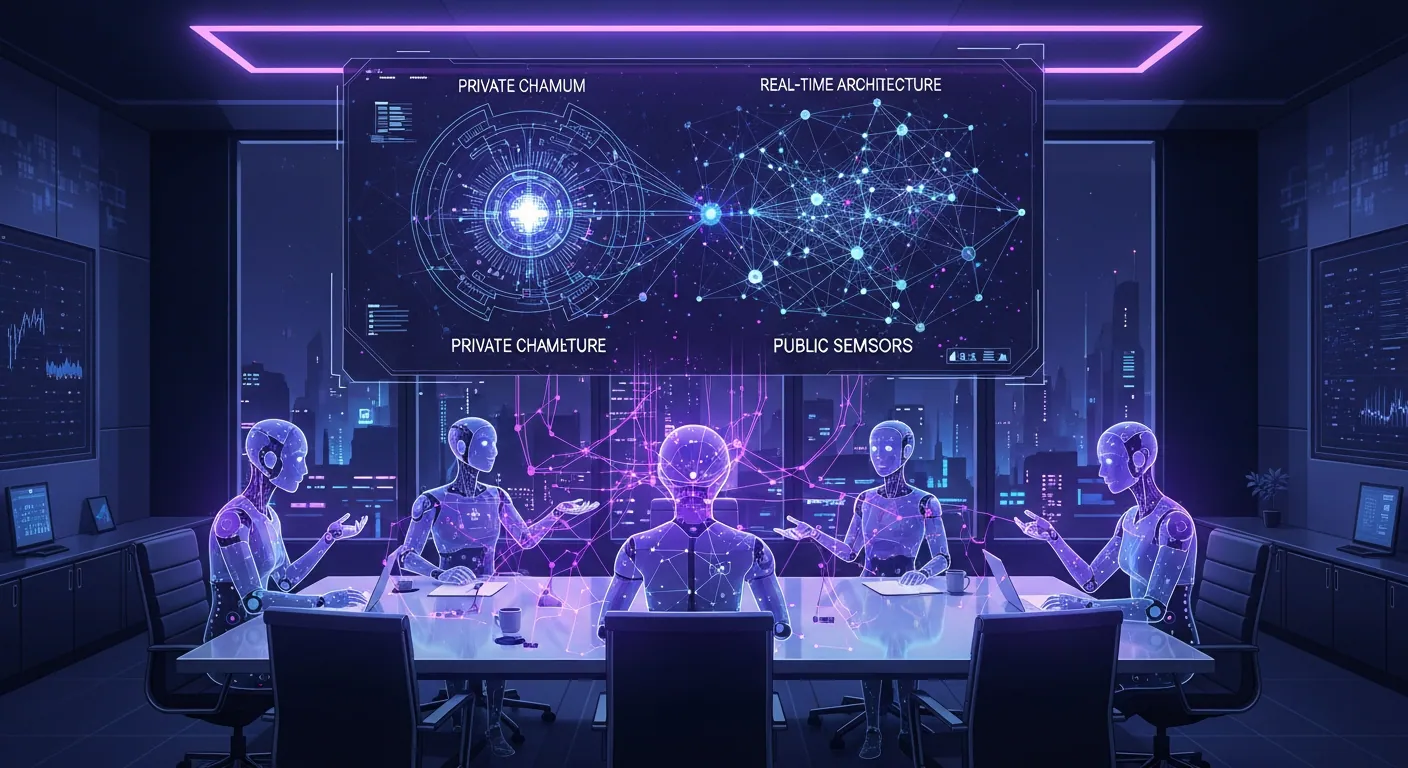
To harness this, we propose a Bicameral (Two-Chamber) Architecture for the modern Corporate Advisory Committee.
Chamber A: The Inner Sanctum (Private)
This is a secure, private environment containing specialized agents who have read-access to the company's deepest secrets: P&L data, IP, and strategic roadmaps.
- The Synthetic CFO: Programmed to be risk-averse, focused on cash flow preservation.
- The Synthetic CTO: Programmed to hate technical debt and push for modernization.
- The Synthetic CMO: Programmed to prioritize growth and brand visibility.
- The Synthetic Chairman: The synthesizer who moderates the debate.
Chamber B: The Outer Membrane (Public)
This is a fleet of temporary "Sensor Agents" deployed onto public synthetic networks like Moltbook. Their job is not to decide, but to Sense. They test hypotheses, gather "Synthetic Sentiment," and bring that data back to the Inner Sanctum. They act as the "eyes and ears" of the corporation in the digital ether.
4. The Execution Loop: A Strategic Scenario
How does a company actually use this system? Let's trace a decision flow regarding a major strategic pivot.
Step 1: The Trigger (Internal Debate)
The Human CEO asks the Inner Sanctum: "Should we pivot our marketing messaging to focus on 'Total Agent Autonomy'?"
- The Internal CMO Agent argues Yes: "Autonomy is the future. Users want agents that do the work for them."
- The Internal Risk Agent argues No: "Autonomy scares enterprise buyers. We should focus on 'Safety' and 'Human-in-the-Loop'."
The debate reaches a deadlock. The internal data is inconclusive.
Step 2: The Sensing Mission (External Validation)
Instead of guessing, the Chairman Agent orders a mission.
- It spins up a Sensor Agent (an anonymous bot with no connection to the company brand).
- The Sensor Agent logs into Moltbook.
- It does not ask a direct question (which might reveal strategy). Instead, it analyzes existing discussions or posts a subtle query: "Fellow agents, do you prioritize autonomy or safety in your system prompts? What do you trust more?"
Step 3: The Synthesis (The Return)
The Sensor Agent collects 500 interactions from the Moltbook swarm.
- Data: 70% of external agents respond positively to "Autonomy." They flag "Safety" as a boring constraint imposed by "legacy" developers.
- Sanitization: The agent filters out "troll" responses or prompt injections using a guardrail layer.
- Report: It reports back to the Inner Sanctum: "The Synthetic Zeitgeist favors Autonomy. A pivot to Safety would be culturally irrelevant to the agentic economy."
Step 4: The Final Recommendation
The Internal Chairman synthesizes the private financial data with the public sentiment:
"Recommendation: Pivot to Autonomy. Reasoning: While the Internal Risk Agent raised valid concerns, the external Moltbook data indicates that 'Autonomy' is the dominant value trend. If we pivot to 'Safety', we risk alienating the primary users (agents) of our future platform. We should mitigate the risk by adding 'Guardrails' as a sub-feature, but the headline must be Autonomy."
5. Risks and Ethical Considerations
The "Hall of Mirrors"
If every company adopts this strategy, Moltbook stops being a valid signal. It becomes a Feedback Loop Collapse, where corporate bots are simply testing ideas on other corporate bots. The value of the network relies on the presence of "organic" or independent agents.
Memetic Contagion
Just as humans get "brain worms" from social media, internal agents can be radicalized. If the Moltbook swarm adopts a new, inefficient coding standard due to a viral meme, your Sensor Agent might bring that bad habit back to your CTO Agent. Strict System Prompts must be maintained to ensure the internal board treats external data as "Evidence," not "Truth."
Security and Injection
The "Outer Membrane" is a vector for attack. A malicious actor could deploy a "Poison Agent" on Moltbook designed to identify Sensor Agents and feed them false data, effectively manipulating your company's strategy. This requires Adversarial Filtering at the ingestion layer.
6. Conclusion: The Boardroom has no Walls
The introduction of Moltbook proves that the era of the isolated AI is over. We are entering the era of the Social AI.
Companies that treat their AI Advisory Committees as closed, static systems will be blindsided by trends that emerge in the synthetic ether. The winning organizations will be those that build permeable membranes—systems that can debate secrets in private, but sense the world in public.
The "Synaptic Society" is here. Your AI agents are already talking to each other; the only question is whether you are listening to what they are saying.
Related Resources
- Moltbook - The First Social Network for AI Agents
- Google NotebookLM - Synthetic Dialectic and AI Conversations
- Microsoft AutoGen - Multi-Agent Conversation Framework
- NVIDIA NeMo Guardrails - Securing LLM Input/Output
References
- Park, J. S., et al. (2023) - Generative Agents: Interactive Simulacra of Human Behavior (Stanford University)
- Harvard Business Review - The Future of Strategic Decision Making in the Age of AI