The Last Office: How AI Will End Commercial Real Estate as We Know It
 Lorenzo Vallone
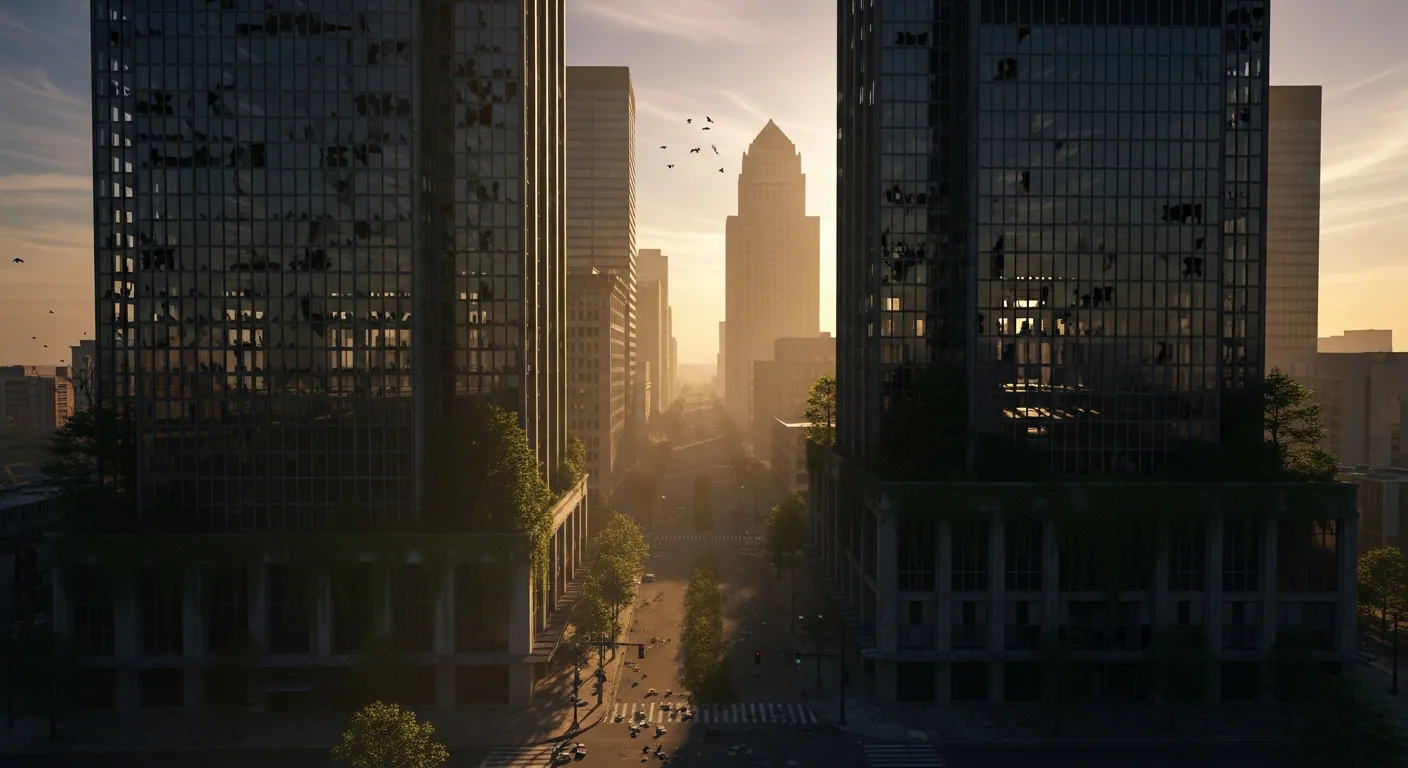
The skyscrapers still stand. Glass towers, 40 stories tall, reflecting the morning sun across a thousand American downtowns. For a century they were the physical manifestation of economic power — concentration of talent, capital, and decision-making in vertical steel boxes at the center of every city worth its name.
But something is quietly beginning to rot inside them.
Not structurally. Not yet. The rot is economic. And its name is artificial intelligence.
The Office Was Already Dying Before AI Arrived
To understand where AI takes us, you first have to understand where we already were. The 2020 pandemic didn't kill the office. But it ran a massive, involuntary experiment that proved something the real estate industry had spent decades denying: most knowledge work does not require physical co-location.
By early 2024, office vacancy rates in major American cities had climbed to historic highs. San Francisco hit 36%. Chicago's Loop cracked 25%. Houston, Dallas, Atlanta — all north of 20%. Even New York, the most resilient commercial market on earth, was sitting at 22% vacancy across its Class A towers. These are numbers that, in any prior era, would signal an acute economic crisis.
Instead, they're now being called "the new normal."
The reason? Companies discovered that hybrid work doesn't require less space — it requires almost no space. When employees come in two days a week, the math no longer works. A 50,000 square foot lease serving 400 employees becomes a monument to sunk cost bias when 300 of those employees are never in the building on the same day.
That's the world AI is about to inherit. And AI is not going to paper over these cracks. It's going to blow the building apart.
What 90% AI Automation Actually Means
The current conversation around AI in the enterprise tends to focus on augmentation — AI making workers faster, smarter, more productive. That framing is deliberately conservative. It papers over a more disruptive truth that economists and labor researchers are only beginning to model: at some threshold of AI capability, the marginal value of adding a human employee approaches zero for a wide class of cognitive tasks.
We're not there yet. But the trajectory is clear and the timeline is compressing.
Consider what a modern AI system can already do without any human in the loop: draft and send contracts, analyze financial statements, write and debug code, manage customer service inquiries at scale, run A/B marketing campaigns, synthesize competitive intelligence, schedule and summarize meetings that never happen, generate quarterly reports, and route escalations.
Now imagine that capability — which exists today in fragmented, specialized form — integrated into a unified agentic layer running across an entire company's operations. Not a tool that workers use. An autonomous system that manages workflows end to end, with humans reviewing outputs rather than producing them.
That shift — from AI as tool to AI as operator — is the inflection point. And once it arrives, the question of why a company needs 80,000 square feet of Class A office space in downtown Chicago becomes very difficult to answer.
The Catalysts That Will Break the Market
Commercial real estate doesn't collapse all at once. It dies by a thousand lease renewals. But there are specific catalysts that will accelerate the process from slow bleed to structural rupture.
1. Agentic AI Reaches Enterprise Maturity (2025–2027)
The first catalyst is already underway. Enterprise AI agents — systems that can execute multi-step workflows autonomously across software platforms — are moving from proof-of-concept to production deployment. When a company's finance, legal, HR, and operations functions can be managed by a small team of agents supervised by a handful of humans, the logic of maintaining a central headquarters dissolves.
The physical office was always, at its core, a coordination technology. It put people in proximity so they could communicate, collaborate, and make decisions faster. AI agents are a superior coordination technology. They operate at machine speed, don't require proximity, and don't need a building.
2. The "Supervisor Class" Goes Fully Remote (2026–2028)
One of the arguments for maintaining office space has been leadership visibility — senior decision-makers need to be accessible, and their presence signals organizational culture. But as AI handles more execution, the nature of leadership changes. The supervisor class becomes a small group of strategists who review AI outputs, set direction, and manage exception cases.
That work — strategic review and exception handling — is extraordinarily well-suited to asynchronous, remote operation. When the CEO's primary job becomes reviewing AI-generated options rather than running meetings, the corner office becomes unnecessary. So does the building it sits in.
3. AI-Native Startups Set the Template (2025–2026)
The most important catalyst may not be what happens inside existing companies. It's what happens outside them. A new wave of AI-native startups — companies built from day one on the assumption that AI handles all operational work — are demonstrating that you can build a $100M business with a team of 12 people and no office lease.
These companies don't need physical space because they were never designed around it. And as they grow and compete with legacy enterprises that carry $10M annual office lease obligations as overhead, the competitive math becomes brutal. The incumbents will be forced to follow. Lease by lease, floor by floor, the demand for corporate office space will contract.
4. Commercial Real Estate Financing Seizes (2027–2030)
The final catalyst is financial rather than operational. Commercial real estate is built on a debt model that assumes stable occupancy and rising rents. When vacancy exceeds a certain threshold — roughly 30% in most markets — the collateral value of the underlying assets falls below the loan balances they secured. Banks stop lending. Refinancing becomes impossible. Owners default.
This is already beginning to happen in the most exposed markets. AI-driven demand destruction will accelerate the timeline, pushing marginal markets past the breaking point well before the end of the decade. When the financing market seizes, the decline becomes self-reinforcing: no capital means no renovation, which means no tenant attraction, which means rising vacancy, which means further collapse in asset values.
The Geography of Collapse
Not all commercial real estate is equally exposed. The impact will be deeply uneven — and the fault lines are already visible.
Most Exposed: Suburban Office Parks
The campus-style office parks that ring every major American city — built in the 1980s and 1990s as companies fled downtown costs — are the most vulnerable assets in the market. They have no residential conversion potential, no pedestrian infrastructure, and no public transit access. They exist solely because companies needed them. When companies stop needing them, there is no Plan B. These properties — millions of square feet across the Sun Belt, the Midwest, and the mid-Atlantic — face obsolescence without a viable alternative use.
Highly Exposed: Secondary Downtown Markets
Cities like Hartford, Cleveland, Providence, Memphis, and Oklahoma City built their downtowns almost entirely around corporate office tenants. With thin residential populations, limited tourism, and no major tech ecosystem to absorb displaced space, their downtown cores face existential pressure. A 25% reduction in office demand in these cities doesn't just create vacancy — it hollows out the economic rationale for downtown itself.
Moderately Exposed: Primary Market Towers
New York, Los Angeles, Chicago, Boston, and San Francisco will absorb the shock better than smaller markets — but they won't escape it. The conversion opportunity is real: residential, life sciences, mixed-use. But conversion is expensive, slow, and structurally constrained. A 60-story glass tower cannot be economically converted to apartments. The math doesn't work. These buildings may simply become stranded assets — too expensive to maintain, too costly to demolish, and impossible to repurpose.
Least Exposed: Mixed-Use Urban Districts
The neighborhoods that combine residential, retail, hospitality, and creative workspace — think the Meatpacking District in New York, River North in Chicago, South End in Boston — are the most resilient. Their value doesn't depend entirely on corporate tenants. They will shrink. They will not collapse.
What Happens to the Cities?
The commercial real estate market is not just an asset class. It is the fiscal foundation of the American city. In most major metros, commercial property generates 30–40% of total property tax revenue. It anchors the value of surrounding residential neighborhoods. It drives demand for restaurants, transit, retail, and services.
When it hollows out, the secondary effects are severe.
Property tax revenues fall, triggering cuts to city services and school funding. Retail corridors — already hammered by e-commerce — lose the lunchtime and evening foot traffic that kept them alive. Transit ridership collapses, pushing public systems toward insolvency. The parking garages, the sandwich shops, the dry cleaners, the bank branches that built their business models around office worker density: they go first.
Then the residential values in surrounding neighborhoods begin to erode — not immediately, not uniformly, but inevitably. A city that cannot fund its schools, maintain its streets, or sustain viable retail is less attractive to residents. Population follows. The cycle deepens.
Some cities will manage the transition with creative policy, adaptive reuse incentives, and deliberate reinvention of their downtown cores. Many will not. The divergence between cities that adapt and cities that decline will be one of the defining geographic shifts of the next two decades.
What Fills the Void
Collapse and creation are not mutually exclusive. The end of the corporate office as the organizing principle of American urban life opens enormous possibilities — if cities and developers move quickly enough to seize them.
Residential conversion — where structurally feasible — can address the housing shortage that plagues every major American city. The federal government and several states have already introduced conversion incentive programs. The economics are challenging but improving as office values fall and residential demand remains strong.
Life sciences and advanced manufacturing represent genuine demand for physical space in ways that pure knowledge work does not. Lab space, biomanufacturing, robotics R&D — these industries cannot be virtualized. Cities that successfully attract this sector will have a viable replacement for office demand.
Hospitality, wellness, and experience — the things AI cannot replace remotely — will fill some of the cultural and social void left by corporate offices. The coworking model, which seemed to collapse with WeWork, may be due for a revival as a genuine alternative to leased corporate space rather than a financial engineering scheme built on arbitrage.
Urban agriculture, data centers, and logistics hubs represent less glamorous but increasingly viable uses for large, centrally located buildings with significant power and water infrastructure.
The Honest Timeline
The end of commercial real estate is not imminent. The leases that tie companies to physical space run 5, 10, and 15 years. The debt structures that underpin the buildings run longer. The regulatory and financial systems that govern commercial property are slow to adapt.
But the direction is unambiguous. And the speed is increasing.
By 2030, expect office vacancy in most major markets to exceed 35%. By 2035, the first wave of high-profile downtown office towers in secondary markets will be demolished or converted — not because someone chose to do it, but because there is no alternative. By 2040, the notion of a company maintaining a large, centralized corporate headquarters as its primary operational hub will seem as anachronistic as the typing pool.
The glass towers will still be there. The question is what they'll be for.
And the answer, increasingly, is: not what they were built for.
ARTE LOGICA covers the strategic and societal implications of artificial intelligence. This article represents speculative analysis based on current AI capability trajectories and commercial real estate market data.