AI Is Getting More Efficient—So Why Are Data Centers Still Using More Power?
 Lorenzo Vallone
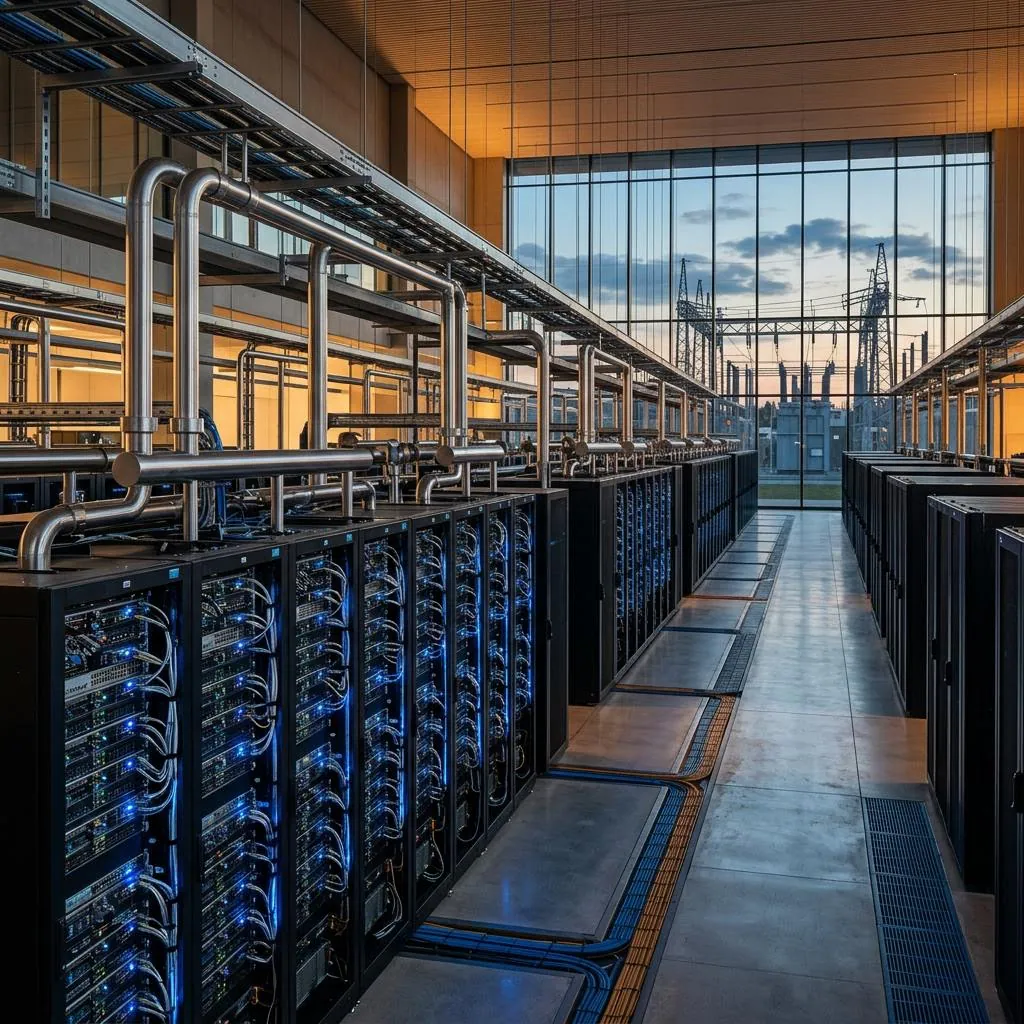
AI is becoming dramatically more efficient. Data centers are still using more electricity.
Those statements are not contradictory. One describes the resources needed to do a particular amount of work. The other describes how much work the world is asking computing infrastructure to do.
That distinction matters for business leaders deciding whether AI is becoming more accessible, communities evaluating new data centers, and investors assessing the enormous infrastructure buildout. Efficiency is real progress. It is not proof that total energy demand will fall—or that every proposed data center will be needed.
Three impressive statistics—and three different measurements
Stanford HAI's 2025 AI Index and the International Energy Agency's 2026 Key Questions on Energy and AI describe substantial improvements. But their headline figures measure different things.
| Performance measure | Reported improvement | What it means—and does not mean |
|---|---|---|
| AI hardware energy efficiency | Stanford reports approximately 40% improvement annually. | About 40% more computation per unit of electricity, equivalent to approximately 29% less electricity for the same computation. Not a 40% reduction in electricity use. |
| Energy per AI task, combining software and hardware advances | The IEA describes energy use per task falling by at least an order of magnitude annually in recent years. | At least tenfold lower energy per task in the trend described—equivalent to at least 90% less energy. Not a promise for every task or future year. |
| Cost of inference at comparable benchmark performance | Stanford reports a more than 280-fold decline between November 2022 and October 2024 for systems performing at GPT-3.5 level. | More than approximately 99.64% lower cost at that performance level. Not a corresponding measured reduction in electricity consumption. |
Sources: Stanford HAI, 2025 AI Index, takeaway 7 and IEA, 2026 executive summary.
The percentages in the final column are arithmetic interpretations of the reported ratios, not additional independent research findings.
Why 40% more efficient does not mean 40% less electricity
Imagine hardware that delivers 100 units of computation per unit of electricity. A 40% efficiency improvement raises that to 140.
To perform the original 100 units of computation, the improved hardware needs 100 ÷ 140, or about 71.4%, of the original electricity. The reduction is therefore approximately 28.6%, rounded to 29%.
This is a like-for-like calculation. Real workloads also depend on memory, networking, utilization, numerical precision, and the surrounding facility. A hardware trend does not automatically describe every installed server or an entire data center.
Why the tenfold and 40% figures cannot be added together
The IEA's broader measure includes both software and hardware advances. Stanford's figure concerns hardware efficiency.
They are not independent savings applied to a single, identically measured workload. Adding 90% to 29%, or multiplying the two improvement factors without a matched baseline, would double-count overlapping gains and mix different measurement boundaries.
Nor should the IEA's recent trend be projected forward indefinitely. The report describes observed progress; it does not promise that every application will use one-tenth as much electricity every year.
Why a cheaper answer is not necessarily an equally greener answer
Stanford's more than 280-fold inference-cost decline is significant for affordability. At exactly 280-fold, a service costing $280 for a fixed amount of benchmark-level performance would fall to $1—approximately a 99.64% reduction.
But this measures cost, not electricity. Prices can reflect hardware and software improvements, utilization, competition, margins, and commercial strategy. Benchmark equivalence also does not establish that two systems behave identically on every business task.
Lower cost expands access. To establish energy savings, we need energy measurements for comparable work, quality, and operating conditions.
Why total electricity demand can rise anyway
For comparable tasks, a useful starting point is:
Total task energy = number of tasks × average energy per task.
If energy per task falls by 90% while the number of tasks grows twentyfold, total task energy doubles: 20 × 0.1 = 2.
That is an illustrative example, not a measurement of actual industry demand. It shows why improving efficiency does not determine the total on its own.
Cheaper, faster AI can encourage organizations to use it more widely. A company that once summarized a few documents may start processing its whole archive. A developer may move from occasional coding assistance to agents repeatedly generating, testing, and revising software.
There is also a changing mix of work. A short text response is not equivalent to generating video, running a long reasoning process, or coordinating an agent that calls models and tools many times. The IEA notes that some video, reasoning, and agentic tasks can consume hundreds or thousands of times more energy per query than simple text generation.
Calling both interactions a “query” can conceal that difference.
This is a rebound effect: reducing the resources or cost needed for a service can stimulate greater use. It does not mean efficiency always increases consumption. Whether demand offsets the savings depends on adoption, prices, capabilities, and what people choose to do.
What the IEA actually reports about demand
The IEA's 2026 report provides evidence that efficiency improvements and growing electricity demand are happening together:
- Global electricity demand grew 17% in 2025.
- Electricity consumption from AI-focused data centers grew 50% that year.
- Its central projection sees total electricity consumption rising from 485 terawatt-hours in 2025 to approximately 950 terawatt-hours in 2030, around 3% of global electricity demand by then.
- Electricity use by AI-focused data centers is projected to triple over that period.
These figures are from the same IEA executive summary. The 2030 numbers are projections, not completed outcomes. They include assumptions about efficiency, uptake, infrastructure, and constraints. Total demand also includes workloads other than AI.
The right conclusion is not that efficiency gains are imaginary. It is that demand growth and more intensive uses can outweigh them. Without efficiency gains, delivering the same expanding workload could require substantially more electricity.
Facility efficiency is another important—but separate—measure
Data centers consume energy for more than servers. Cooling, electrical conversion, and distribution also require power.
Power Usage Effectiveness, or PUE, is total facility energy divided by IT equipment energy. A PUE of 1.2 means that for every unit used by IT equipment, the facility consumes 1.2 units overall, including 0.2 units of overhead.
In its published efficiency disclosures, Google reports a 2025 fleet-wide average PUE of 1.09. That is a company-reported facility metric, not a claim that every data center achieves the same result.
For a hypothetical fixed IT load, improving PUE from 1.2 to 1.1 reduces total facility electricity by about 8.3%. It halves the overhead portion, from 0.2 to 0.1, but does not halve total energy.
PUE also does not tell us whether a model is useful, whether servers are productively utilized, how much water cooling requires, or how carbon-intensive the electricity is. A facility can have excellent PUE while inefficient software wastes computing resources inside it.
Better cooling, power delivery, scheduling, hardware, and models all matter. Their benefits need clearly defined measurement boundaries before they can be compared or combined.
More efficient does not mean unlimited—or automatically sustainable
Electricity consumption is not the same as carbon emissions. Emissions depend on how and when electricity is generated. Water use, local grid capacity, equipment manufacturing, and hardware replacement cycles introduce further considerations.
Annual energy totals also differ from peak power requirements. A region can face a grid-connection bottleneck even if a proposed facility has efficient servers and cooling.
For communities, the relevant questions include who pays for new infrastructure, how demand develops as servers are installed, and whether electricity and water systems can support the project. For investors, falling inference costs may expand demand while also pressuring revenue per unit of service.
Our analysis of AI funding risks addresses that financial side. Technical progress and successful investment returns are connected, but neither guarantees the other.
What small and midsize organizations should do
The practical opportunity is to obtain more useful work from AI without treating computing as free or unlimited.
- Measure completed business outcomes. Track cost, quality, latency, and human review per accepted result—not just the price of a million tokens. Repeated failures and retries count.
- Use the least demanding approach that reliably meets the need. A smaller model, conventional search, a database query, or ordinary automation may be sufficient. Reserve expensive reasoning and multimodal generation for tasks that benefit.
- Reduce unnecessary work. Reuse appropriate cached results, avoid repeatedly sending irrelevant documents, limit unnecessary output, and put bounds on agent loops. Preserve privacy and freshness requirements when caching.
- Ask providers what their numbers include. Does an energy estimate cover the accelerator, server, or full facility? Does it include input processing and output generation? Are quality and workload comparable?
- Evaluate deployment choices rather than assuming ownership is greener. An underused private GPU can be a poor operational choice. A managed service can improve utilization, but shared hosting alone does not prove lower emissions. Our open-weight deployment guide explains the responsibilities behind the options.
Where reliable energy data are unavailable, say so. Token counts and spending can help manage usage, but they are not direct electricity or emissions measurements.
The opportunity is real; the accounting must be honest
AI's efficiency gains deserve attention. They are making useful capabilities more affordable and can reduce the resources needed for comparable work.
They do not justify dismissing energy concerns. Nor does rising electricity consumption justify pretending that hardware, software, and facility improvements have achieved nothing.
AI can become much more efficient per task while consuming more electricity in total. The goal should be more valuable outcomes with less avoidable computation—and transparent accounting of the resources that still requires.
Sources are linked beside the claims they support. Stanford's figures are from its 2025 report; the IEA's figures are from its 2026 report. Historical trends are not guarantees of future annual improvement. Arithmetic examples are illustrative, not forecasts. The banner is an AI-generated editorial illustration, not a photograph of a named facility.