Beyond the Co-Pilot: When Enterprise Systems Start Building Themselves
 Lorenzo Vallone
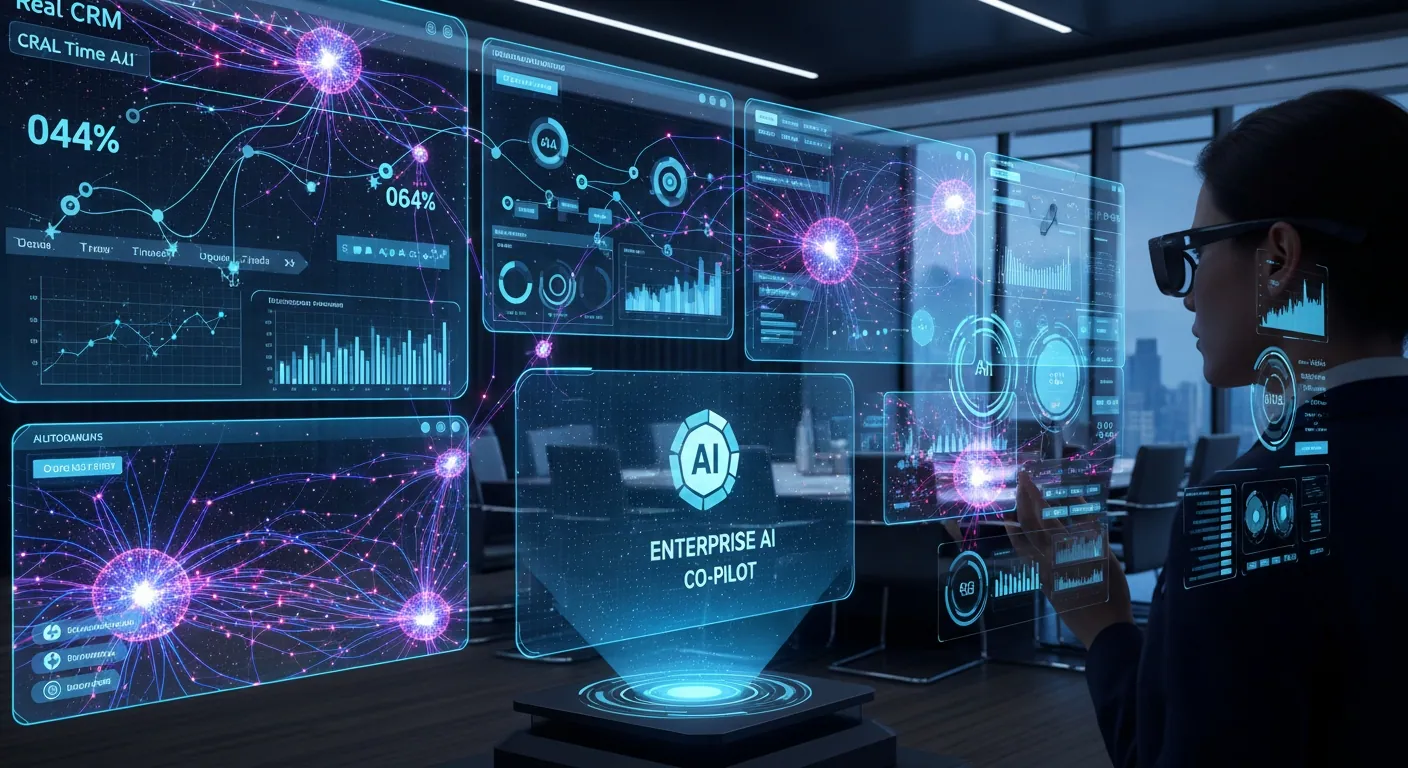
Tony Leone recently published a compelling piece on LinkedIn titled "The CRM Doesn’t Wait Anymore. It Listens. It Sees. It Decides With You." The article lays out a vision where CRM systems stop being passive databases that sales teams reluctantly update at the end of the day and start functioning as real-time operational co-pilots. Through smart glasses, voice commands, and computer vision, the CRM becomes a living system that captures context as it happens — during field visits, trade shows, technical inspections, and client conversations. The data entry problem disappears because the system is always listening, always watching, always learning.
Leone’s argument is grounded in practical use cases. A field sales rep wearing smart glasses walks into a client meeting, and the CRM automatically pulls up account history, past interactions, and predictive insights. A technician inspects industrial equipment and the system captures images, matches serial numbers, logs conditions, and generates service recommendations without a single manual entry. At a trade show, the CRM scans badges, captures conversation context through voice, and qualifies leads in real time. The ROI figures Leone presents are striking — 60 to 70 percent reductions in data entry time, 15 to 25 percent improvements in close rates, and payback periods of six to twelve months.
But what strikes us most at ARTE LOGICA is where this trajectory leads when you extend it to its logical conclusion. Leone describes a CRM that listens, sees, and decides with you. We believe the next evolution is a system that builds for you.
From Co-Pilot to Architect
The CRM that Leone describes is still fundamentally a tool that assists human operators. It surfaces insights, captures data, and presents recommendations. The human makes the final decision and executes the action. But consider what happens when you combine the capabilities Leone outlines — real-time data capture, computer vision, contextual awareness, predictive analytics — with the kind of generative AI systems that are now producing working software from natural language prompts.
We wrote recently about how Google’s Gemini Canvas is turning text prompts into interactive 3D experiences using Three.js and WebGL. That same generative capability — AI that produces functional, deployable code — can be directed inward at enterprise systems themselves. Instead of building software that helps humans do their jobs better, we are approaching a point where the software builds itself to meet the needs it observes.
Imagine a system that does not just capture data from a field technician’s smart glasses. It analyzes patterns across thousands of service visits, identifies recurring failure modes, and then generates a custom diagnostic application tailored to that specific equipment type and client environment. No product manager wrote the requirements. No developer coded the interface. The system observed the need, understood the context, and built the solution.
Strategy as Input, Software as Output
Enterprise software has always been built through a chain of human translation. Business leaders articulate strategy. Product managers translate strategy into requirements. Designers translate requirements into interfaces. Developers translate interfaces into code. Each translation introduces delay, distortion, and cost.
Self-developing environments collapse this chain. The inputs are strategy documents, organizational goals, market data, customer interactions, operational metrics, and competitive intelligence. The outputs are working software systems — dashboards, workflows, integrations, automation rules, and even entirely new applications — that directly serve the stated objectives.
This is not science fiction. The building blocks already exist. Large language models can generate production-quality code. AI agents can orchestrate multi-step workflows autonomously. Computer vision systems can parse documents, scan environments, and extract structured data from unstructured sources. What is missing is the orchestration layer that connects organizational intent to autonomous software generation.
Leone’s vision of a CRM that captures everything in real time provides the data foundation. When every customer interaction, every field observation, every competitive signal, and every operational metric flows into a unified intelligence layer, the system has enough context to identify gaps between current capabilities and strategic goals. Those gaps become the specifications for new software that the system generates, tests, deploys, and iterates on automatically.
Internal and External Data as the Development Engine
The power of self-developing systems comes from their ability to synthesize both internal and external data streams. Internal data includes CRM records, financial systems, HR platforms, operational databases, communication archives, and institutional knowledge bases. External data includes market trends, competitor movements, regulatory changes, customer sentiment across social channels, technology developments, and macroeconomic indicators.
A self-developing enterprise environment would continuously monitor these streams and identify opportunities or threats that require new capabilities. If customer churn analysis reveals that clients in a specific industry segment are leaving after their second year, the system does not just flag the insight in a dashboard. It generates a retention workflow — complete with personalized outreach sequences, risk scoring models, and escalation protocols — and deploys it into the operational environment for immediate use.
If competitive intelligence shows that a rival has launched a new product category, the system generates market analysis tools, adjusts sales playbooks, creates comparison documentation, and reconfigures lead scoring to account for the changed landscape. The enterprise does not wait for a quarterly strategy review. The software evolves in response to the data as it arrives.
The Role of Human Judgment
This does not eliminate humans from the equation. It elevates their role. Instead of spending time on implementation details — writing requirements, reviewing mockups, managing sprints, testing deployments — leaders focus on defining values, setting boundaries, and making judgment calls that AI cannot and should not make on its own. The system proposes. The human approves, adjusts, or redirects.
Leone describes this dynamic in the context of CRM: the system surfaces insights and the human decides. In a self-developing environment, the system surfaces entire solutions and the human decides whether to deploy, modify, or reject them. The feedback loop between human judgment and autonomous generation becomes the primary driver of organizational capability.
What This Means for the AI Landscape
At ARTE LOGICA, we track and catalog the tools, platforms, and technologies that are making this future possible. Our directory spans twelve categories of AI — from Large Language Models and AI Agents to Automation, Robotics, and Full Self-Driving — because the convergence of these technologies is what creates self-developing systems. No single tool does it alone. It takes LLMs for code generation, agents for orchestration, computer vision for environmental awareness, automation platforms for deployment, and data analytics for continuous learning.
Our 3D Explore Gallery visualizes these connections in an immersive space where you can see how different AI categories relate to each other and discover the resources that are pushing each domain forward. The future Leone describes — where CRM becomes a distributed operational nervous system — is one piece of a much larger transformation where every enterprise system becomes intelligent, adaptive, and self-improving.
The CRM that listens, sees, and decides with you is the beginning. The enterprise that designs, builds, and evolves its own software is where this is all heading. The organizations that recognize this trajectory early and begin assembling the capabilities — real-time data capture, generative AI, autonomous agents, strategic alignment frameworks — will have an extraordinary advantage over those still waiting for humans to translate strategy into spreadsheets and spreadsheets into software.
The tools are here. The vision is clear. The question is who moves first.