The Spatial Age: Spatial Computing's WordPress Moment
 Lorenzo Vallone
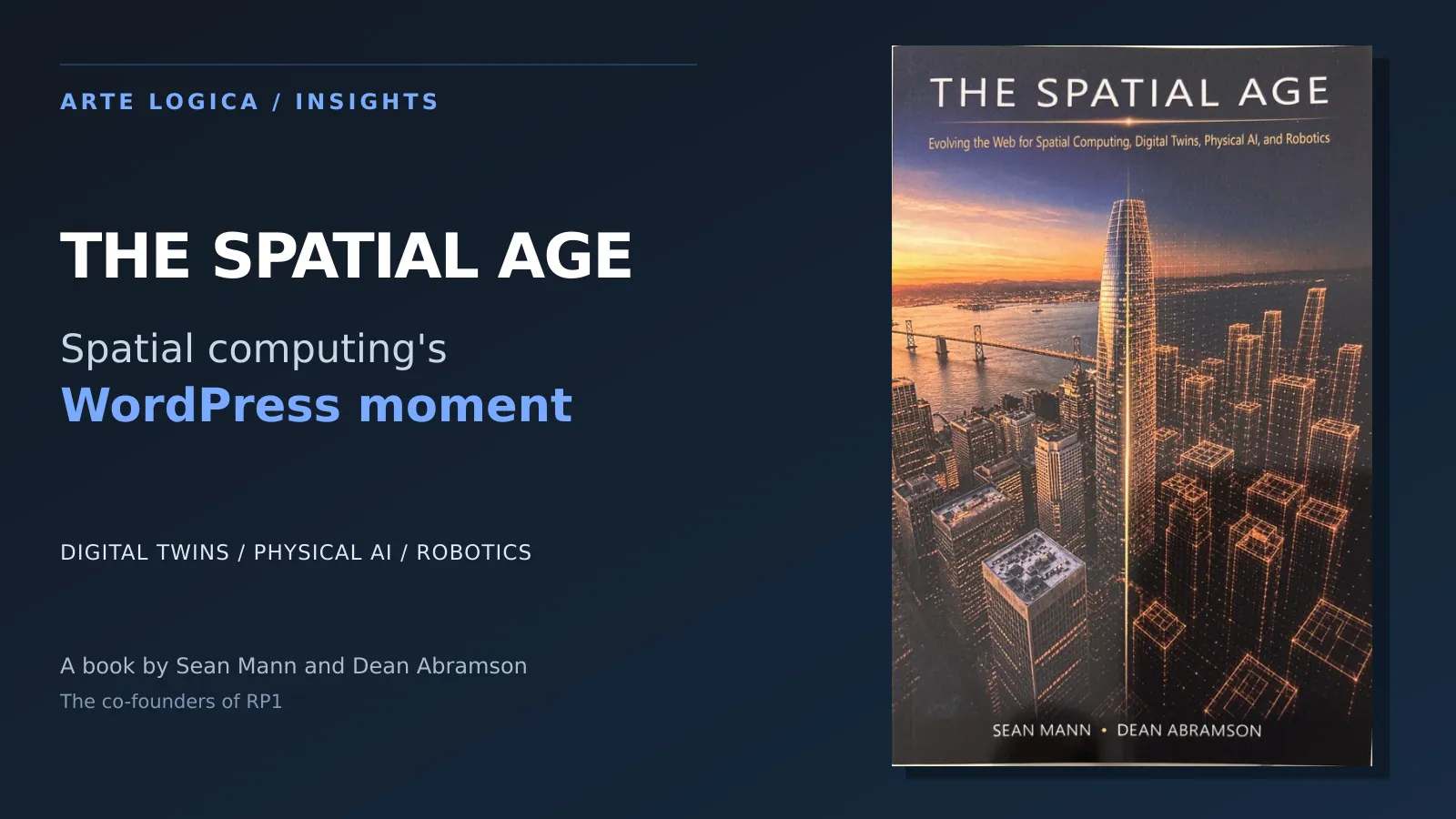
The next big opportunity in spatial computing may not be another headset, another game engine, or another virtual world. It may be something much more useful: making spatial experiences as practical to create, publish, and operate as a website.
That is the idea that caught my attention in The Spatial Age: Evolving the Web for Spatial Computing, Digital Twins, Physical AI, and Robotics, the 2026 book by Sean Mann and Dean Abramson, co-founders of RP1. Mann is RP1's CEO; Abramson is its Chief Architect. Their company is building infrastructure for an open spatial internet, rather than a single destination within it.
The book connects subjects we often discuss separately: smart glasses, digital twins, intelligent machines, real-time environments, and the economics of building software. Its strongest argument is that these technologies need a common foundation if they are going to become useful together.
Chapter 16 gives that opportunity a memorable name: “The WordPress Moment for Spatial Computing.”
What a WordPress moment actually means
The analogy is not that WordPress is about to turn into a 3D engine. It is about what happens when a shared publishing foundation lets an entire industry build tools on top of it.
In Chapter 16 of the book, Mann and Abramson describe how the web became easier to build for as competing editors, hosting companies, frameworks, and content-management systems grew around common standards. A company could create a website without also creating a browser or persuading its customers to adopt a proprietary runtime.
WordPress became a familiar example of that separation: the publishing tool, the host, and the person visiting the site do not all have to belong to one vendor.
Spatial computing has excellent creation tools, but moving a 3D asset between tools is not the same as moving a complete working experience. Behavior, identity, permissions, data connections, and deployment often remain tightly coupled to a particular platform.
The authors' proposal is to make spatial fabrics—their term for spatial places with content and services—serve a role analogous to websites. Different tools could publish them, different organizations could host them, and compatible browsers could open them.
My takeaway is straightforward: the important breakthrough is not making one more impressive demo. It is making useful spatial applications easier to build, maintain, and move.
Four technologies, one physical world
The book's subtitle names four areas that belong in the same conversation. They overlap, but they are not interchangeable.
Spatial computing places digital information and interaction within three-dimensional environments. For people, that might mean a maintenance instruction appearing beside a machine, rather than on a separate screen.
Digital twins represent real assets, places, or processes. A useful operational twin needs more than attractive geometry: it needs relevant state, connections to the real system, and an understood update process. A static scan can be valuable, but it does not automatically become a live twin.
Physical AI concerns intelligent systems that perceive, reason about, or act within the physical world. It brings questions of distance, geometry, motion, uncertainty, and changing conditions into AI development.
Robotics gives some of those systems the ability to take physical action. It also introduces requirements that a website does not face: safe motion, local sensing, emergency stops, and accountable control.
All four need answers to related questions. Where is this object? Which coordinate frame describes it? How recent is the information? Who may see it? Who may change it? Which actions are permitted?
That is why the infrastructure discussion matters. A person wearing smart glasses, a digital twin displaying machine state, and a robot working nearby may need to understand the same place—even when their software comes from different suppliers.
The research makes the connection concrete
This is not only an argument about the future of the metaverse. There is active research into the capabilities and limitations of AI in spatial environments.
The VSI-Bench research paper, Thinking in Space: How Multimodal Large Language Models See, Remember, and Recall Spaces, evaluates visual-spatial reasoning using more than 5,000 question-answer pairs. Its authors find that the evaluated models demonstrate meaningful but subhuman spatial intelligence, with spatial reasoning remaining a primary bottleneck.
The implication is important: recognizing an object in an image does not establish that a model can reliably reason about its position, dimensions, or relationship to other objects. Giving an assistant a camera is not the same as giving it dependable spatial understanding.
Meanwhile, NVIDIA Cosmos provides world foundation models and data-processing, training, and evaluation tools for physical AI. Its robotics and autonomous-vehicle workflows illustrate another part of the convergence: environments can supply training and evaluation data, not just content for a person to view.
Neither source proves that one shared spatial platform is the answer. Together, they show why better world representations, testing environments, and interoperable data deserve attention.
My view is that shared spatial information could reduce duplicated work and improve context. It would not remove the need to test models, validate sensors, handle uncertainty, or engineer safe systems.
What RP1 is building—and what is still early
There is practical work behind the book's argument.
The Open Metaverse Browser Initiative brings RP1 together with the Metaverse Standards Forum around an open browser foundation. In June 2026, RP1 and the Forum announced Sneeze, an open-source metaverse browser engine released under the Apache 2.0 license.
According to the joint announcement, the architecture addresses capabilities such as composing scenes from multiple origins, isolating service code, real-time 3D rendering, and proximity-based discovery.
RP1 also develops Artemis, a native browser built on that foundation. Its current product page describes Artemis as early alpha, with additional platform support and discovery features still on the roadmap.
That qualification matters. An open-source engine, a standards effort, a commercial browser, and a mature cross-vendor ecosystem are different things. Progress in one does not mean all four are finished.
The book's WordPress analogy is best understood as a direction for the industry—not a claim that spatial publishing already has the ease, reach, or operational maturity of the web.
Open files are necessary, but not sufficient
One of the most useful distinctions in Chapter 16 is between a portable asset and a portable service or experience.
Formats such as glTF help move 3D models between tools. OpenUSD can describe and compose complex scenes. Those are important foundations. But exchanging a model does not, by itself, solve how independently hosted services are discovered, authenticated, composed, or safely executed.
The authors discuss WebAssembly as a way to make program execution more portable. They also acknowledge that portable code needs standardized interfaces: the program must know which functions it can call and what those functions mean.
This is where the WordPress comparison becomes demanding rather than merely optimistic. A healthy ecosystem needs:
- Common publishing targets, so tools do not each produce incompatible experiences.
- Meaningful portability, including behavior and service connections where possible—not just exported geometry.
- Hosting choices, with clear ownership of data and content.
- Identity and permission controls, especially for private or sensitive locations.
- Compatibility testing, so “open” translates into systems that actually work together.
- Usable authoring tools, documentation, and a viable market for the people who build and operate them.
Open source helps people inspect and contribute to software. Open standards help different implementations agree on behavior. Neither automatically guarantees portability, security, or business continuity. Those outcomes have to be demonstrated.
What this could look like in a business
Consider a hypothetical manufacturing site.
A technician needs the current service procedure for a machine. A remote specialist needs to see the relevant equipment and sensor readings. An inspection robot needs to navigate the floor and report observations. A training team needs a safe environment in which to rehearse a maintenance task.
Today, those requirements may become four separate integrations, four representations of the location, and four sets of permissions.
A shared spatial foundation could let those systems reference common asset identifiers and location information while maintaining distinct responsibilities. The technician could see guidance in context. The twin could supply current state. The remote specialist could collaborate around the same equipment. The robot could contribute observations through an authorized interface.
The example is an architectural possibility, not a claim about an RP1 customer deployment.
It also does not mean a cloud-hosted map should directly control a robot. Physical systems still need current local perception, safety-rated controls where required, conservative behavior when data is stale, and a clear separation between viewing information and authorizing action.
For businesses, the potential value is less repeated integration, better continuity between workflows, and fewer expensive dependencies—not simply a more immersive interface.
Why this fits our AI conversation
In our discussion of physical AI and robots learning useful real-world behaviors, the central question was how intelligence becomes capable action. In my Ray-Ban Meta glasses project, the question was how technology can help in an ordinary physical task without continually pulling attention down to a screen.
The Spatial Age adds the infrastructure question: what must exist underneath those experiences so they can connect, persist, and scale without starting over inside each new platform?
That is highly relevant to AI product development. Generating code or a 3D scene is getting easier. The harder work is connecting it to reliable data, other systems, people, permissions, and an operating model that survives beyond a prototype.
I am optimistic about the convergence of AI, spatial computing, and robotics. I am also interested in the unglamorous work that makes that convergence useful: interoperable systems, maintainable applications, responsible controls, and tools that more people can actually use.
What I will be watching
The real test of a WordPress moment will be whether teams can build useful spatial applications with less specialized effort—and retain meaningful control over the result.
Can a business change hosts without rebuilding its entire experience? Can independent tools publish compatible content? Can a digital twin, an AI service, and a human interface share context without unnecessarily sharing private data? Can smaller teams deliver something reliable, rather than only demonstrate something visually impressive?
Those are better measures than counting virtual worlds or announcing another platform.
Sean Mann and Dean Abramson have put a clear argument on the table: the next layer of computing should connect the digital and physical worlds without giving one company permanent ownership of the connection.
If the industry can deliver the tools and standards to support that, the WordPress moment will not just make spatial computing easier to describe. It will make it easier to build something useful with it.
The book and further reading
The Spatial Age: Evolving the Web for Spatial Computing, Digital Twins, Physical AI, and Robotics
Authors: Sean Mann and Dean Abramson
Publisher: Armada-Benson Publishing, 2026
Paperback ISBN: 978-0-9798661-9-7
- Official book page, download, and numbered endnotes
- RP1 company profile in the ARTE LOGICA directory
- Open Metaverse Browser Initiative
- VSI-Bench research paper
- NVIDIA Cosmos physical AI tools
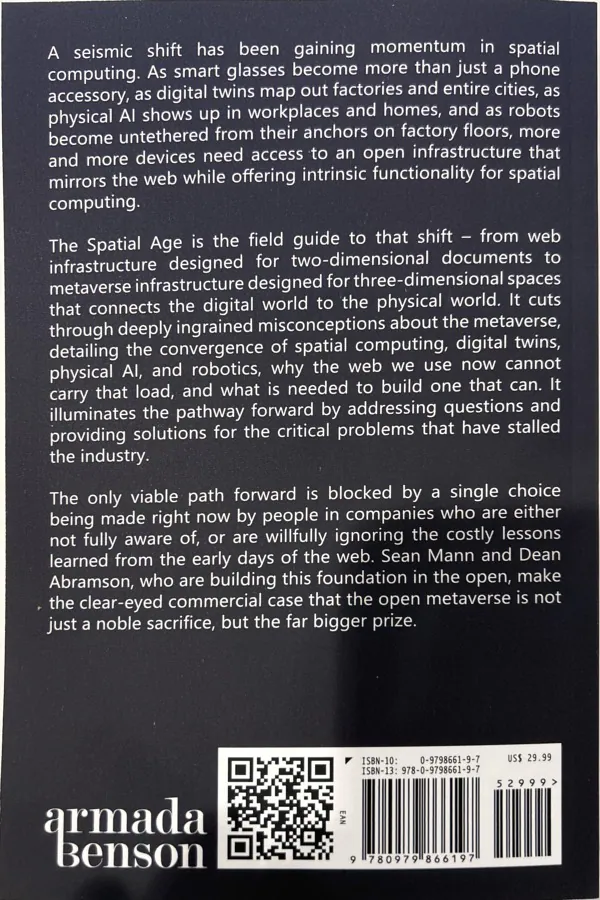
Cover photographs supplied by Lorenzo Vallone; book artwork and text belong to their respective rights holders.
Analysis by Lorenzo Vallone. This article draws on the supplied covers, selected chapters of the publicly available book—especially Chapter 16, printed pages 123–128—and the linked research and technical documentation. Product status was checked on October 12, 2026. This is independent editorial coverage, not an announcement of a commercial partnership with RP1.